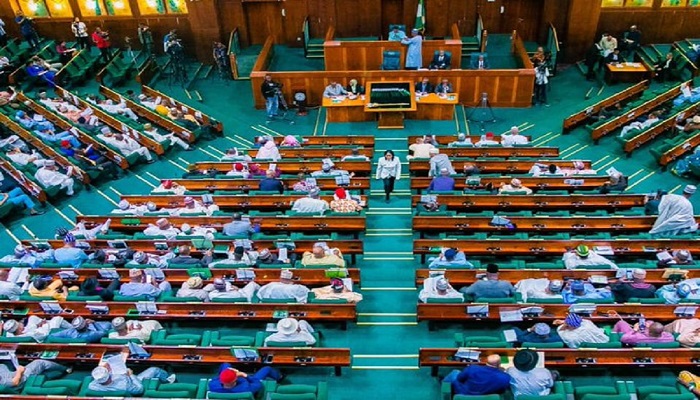

The House of Representatives has urged the Federal Government to take urgent steps to stop the use of hazardous pesticides across Nigeria, warning that the continued circulation of such chemicals poses serious threats to public health, food safety, and the environment.
The lawmakers also called on the Federal Ministry of Industry, Trade, and Investment to revive moribund industries across the six geopolitical zones through its Industrial Inspectorate Department and to include ₦350 million in the 2026 budget to begin the process.
These resolutions followed the adoption of a motion titled “Stoppage and Mitigation of Risks Associated with the Use of Hazardous Pesticides Across Nigeria”, sponsored by Hon. Clement Jimbo during Wednesday’s plenary.

Presenting the motion, Jimbo said that while pesticides play a vital role in crop protection, many of those circulating in the country are classified as Highly Hazardous Pesticides (HHPs), which have been banned in several nations due to their toxicity.
Citing data from the National Agency for Food and Drug Administration and Control (NAFDAC), he revealed that over 50 percent of registered pesticides in Nigeria fall under the HHP category. He further noted that around 70 percent of suicide cases in the country are linked to the ingestion of extremely toxic chemicals such as Dichlorvos (DDVP), popularly sold as Sniper.
Jimbo warned that indiscriminate importation and use of these chemicals have contaminated water sources and soil, endangering farmers, consumers, and wildlife. He also decried the rejection of Nigerian agricultural exports abroad over chemical residue concerns, stressing that seven of the 13 commonly used pesticide ingredients in the country are carcinogenic.
He recalled the 2020 tragedy in Oyo Obi Community, Benue State, where more than 270 people reportedly died after a local river was polluted with the banned pesticide Endosulfan.
On industrial development, Jimbo expressed concern over the collapse of key manufacturing firms but said President Bola Tinubu’s administration has the opportunity to revive them. He mentioned industries such as the Osogbo Steel Rolling Mill, Osogbo Machine Tools, and Umuahia Ceramic Industry as strategic assets capable of creating jobs, boosting production, and reducing import dependence.
The House adopted the motion and directed its Committees on Industry and Legislative Compliance to ensure implementation and report back within four weeks for further legislative action.

- Military arrests 53 terror aides in one week - March 29, 2026
- Pastor weds autistic man to older woman after public backlash - March 29, 2026
- Senior ISWAP commander Al-Muhajir killed in Malam Fatori - March 29, 2026