Prices of livestock and staple food commodities have surged across major markets in Kano and Kaduna states, with rams now selling for as much as N1 million and cows fetching up to N2.5 million, as traders and buyers link the spike to rising demand ahead of the Eid-ul-Adha festival.
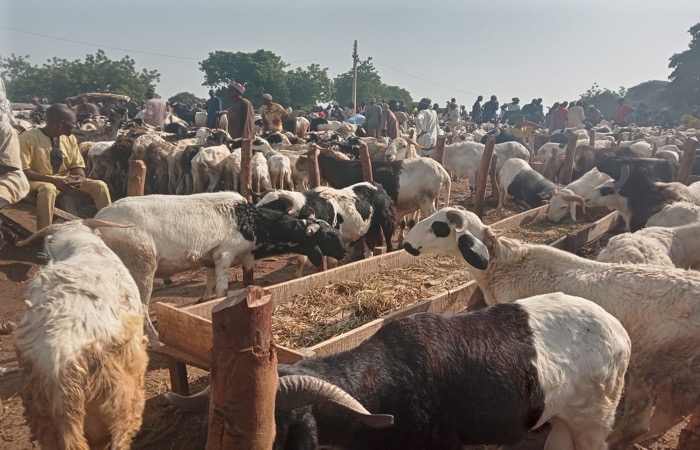
At one of the livestock trading centres at Gandu, Kano, visited by THE STAR, Aliyu Musa, a ram seller, stood beside a row of well-fed rams tied to a wooden post, fielding offers from a cluster of prospective buyers.
He said he would not accept anything below N350,000 for his smallest animals.
“The cost of feeding these rams for months, hiring a truck to bring them here, and the price of fuel — everything has gone up. If I sell below this price, I go home at a loss,” Musa said.
A few metres away, Kabiru Saleh, a father of five who had come to purchase a ram for Sallah, shook his head as he walked away from a negotiation that broke down over price. The seller had quoted N650,000 for a mid-sized ram which Saleh considered fairly ordinary.
“Last year I bought a ram of this same size for N300,000. Today they are telling me seven hundred thousand. How do ordinary people celebrate Sallah at this rate?” he said, visibly frustrated.
A market survey conducted by THE STAR across livestock trading centres in both states revealed that rams are currently selling between N350,000 and N500,000 for small to medium-sized animals, while larger, well-built rams command prices of up to N1 million. Sellers attributed the wide price variation to body weight, age, and breed, noting that demand from urban buyers has driven prices beyond last year’s levels.
The situation is no different for cattle. Cows are presently trading from N1.2 million for smaller sizes, rising steeply to N2.5 million and beyond for larger bulls considered premium for slaughter.
Mallam Bala Garba, a cattle dealer at one of the major livestock markets in Kawo Market, Kaduna, said he transported three bulls from Plateau State at considerable expense and was in no mood to negotiate below his asking price of N2 million per animal.
“I spent over N150,000 on transportation alone for these three cows. The road is not safe, the checkpoints are many and every one of them costs money. By the time the animal reaches the market, the price has already been built into him,” Abdullahi said, patting the flank of one of his bulls.
Away from livestock, the cost of feeding a household has also climbed sharply. At Rimi Market in Kano, a 50kg bag of rice now sells between N50,000 and N55,000, with the price differential reflecting differences in grain quality and milling purity.
Hadiza Yusuf, a trader at Singer Market who has sold rice for over a decade, said prices were largely being driven by rising transportation costs from the mills.
“The bags arrive at a higher landing cost than before. We are not cheating customers — we are simply passing on what we paid,” she said.
At Yankaba Market, also in Kano, a basket of fresh tomatoes is currently priced between N50,000 and N60,000. Bashir Danmusa, a tomato wholesaler who sources his produce from farms in Rogo, said the freshest consignments command the upper end of the price range and are usually gone within hours of arrival.
“Buyers know the difference between tomatoes that came today and those that have been sitting since yesterday. The fresh ones go for N60,000 and nobody argues,” he said.
A food vendor, Hajiya Nana Sule, who buys tomatoes at Yankaba for her bukateria business, said the prices were making it nearly impossible to keep meal costs affordable for her customers.
“I cannot increase my prices every week because my customers are also suffering. But I also cannot absorb these market prices alone. Something has to give,” she said.

- Trump’s press secretary quits days after controversial White House debut - October 17, 2026
- Mob sets BRT bus ablaze after motorcyclist’s death in Lagos - October 17, 2026
- Maina’s son arrested in Abuja after fleeing money laundering trial - October 17, 2026