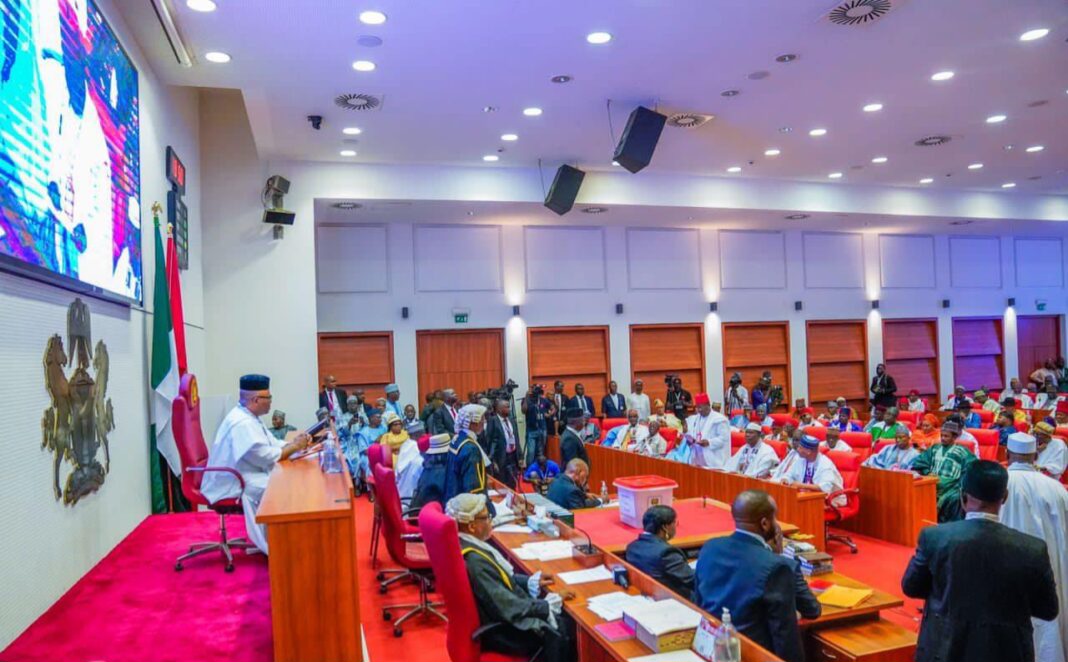

The Senate on Wednesday suspended further consideration of the Electoral Act (Repeal and Amendment) Bill, 2025, to allow for wider consultation and more detailed scrutiny of its provisions.
The bill, which seeks to repeal the 2022 Electoral Act and replace it with a new framework, aims to strengthen Nigeria’s electoral system through innovations such as digital result registers, QR-coded voter identification cards, and stricter timelines for party primaries and result transmission.
Leading debate on the general principles of the bill, Chairman of the Senate Committee on INEC, Senator Simon Lalong, said the 2023 general elections exposed significant weaknesses in the current law, including funding delays, disputes over the voter register, and ambiguities in result transmission.
He explained that the new legislation would promote transparency, efficiency, and integrity in the electoral process while reinforcing the independence of the Independent National Electoral Commission (INEC).
“The key objectives of this bill are to guarantee free and fair competition among political parties, strengthen INEC’s autonomy, and rebuild public confidence in our elections,” Lalong stated.
However, debate on the bill was interrupted when Senator Emmanuel Udende (Benue North East) noted that copies of the proposed legislation were not circulated to members for detailed review.
Deputy Senate President Jibrin Barau, who presided at the time, clarified that the second reading focused on general principles, with detailed clause-by-clause review to be handled by the relevant committees.
Despite broad support from lawmakers such as Senators Titus Zam (Benue North West) and Binos Yaroe (Adamawa), some members raised concerns about specific provisions.
Senate President Godswill Akpabio, who later presided, shared his own experiences from past elections and stressed the need to hold INEC accountable for electoral infractions. He also called for a review of campaign timelines, warning that extended campaign seasons disrupt governance.
“In a four-year term, government performance suffers when ministers and public officers spend nearly a year campaigning,” Akpabio cautioned.
He proposed that senators be given more time to study the bill and suggested a closed session for further briefing.
Following deliberations, Senate Leader Opeyemi Bamidele moved a motion to step down the bill for additional consultations. The motion, seconded by Minority Leader Abba Moro, was unanimously adopted.
Bamidele explained that the decision would allow lawmakers to engage stakeholders and ensure the amendments reflect the aspirations of Nigerians.
Akpabio reaffirmed that while the bill’s intent to modernise Nigeria’s electoral process was commendable, it was essential for senators to reach a shared understanding before moving to the committee stage.

- Kosofe LG chairman denies N100m empowerment fraud allegation - March 14, 2026
- FAAC distributes N1.894trn February revenue to FG, states, LGs - March 14, 2026
- Thugs abduct mortuary attendant, disrupt mass burial in Benue - March 14, 2026