

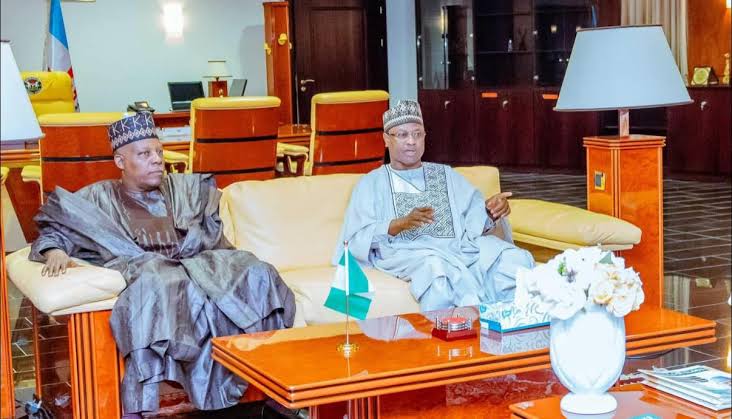

Vice President Kashim Shettima has commended Kaduna State Governor Uba Sani for establishing the Kaduna State Council on Skills, describing the initiative as a benchmark for other states and a model aligned with the federal government’s Renewed Hope Agenda.
The commendation was conveyed in a letter from the National Council on Skills following its last session, where the governor’s leadership in personally chairing the state council was specifically noted.
“By creating a dedicated institutional framework for skills development, Kaduna State has demonstrated a proactive commitment to addressing the unemployment gap and fostering human capital development in line with our national objectives,” Shettima wrote.
The Vice President described the Kaduna initiative as a testament to Governor Uba Sani’s vision of integrated economic growth, adding that the National Council on Skills regards the model as a vital template for a bottom-up approach to skills acquisition — one designed to ensure vocational and technical training reaches the grassroots effectively.
Shettima urged the governor to sustain the momentum, expressing the council’s readiness to collaborate with the Kaduna State Council to harmonise standards and scale the impact of interventions.
The commendation comes on the back of significant investments by the Uba Sani administration in technical and vocational education. The state has established three Kaduna State Institutes of Vocational Training and Skills Development, located at Soba, Rigachikun, and Samarun Kataf — spread across the three senatorial zones — with a combined capacity to produce 12,000 artisans annually.
Trainees at the institutes are being equipped in welding, aluminium fabrication, fashion design, solar panel installation, and other trades, with certificates awarded upon completion. The state government is partnering with the National Board for Technical Education for the formal certification of courses.
Beyond the institutes, Governor Uba Sani plans to transform the Panteka Market — home to an estimated 3,800 artisans — into an industrial hub, covering trades such as welding and fabrication, carpentry and joinery, and masonry.

- TUC to FG: Use excess crude revenue to bring down petrol price - April 9, 2026
- Shettima hails Uba Sani, says Kaduna sets benchmark on skills devt - April 9, 2026
- Job racketeering: Otu suspends C’River LG recruitment, orders probe - April 9, 2026