

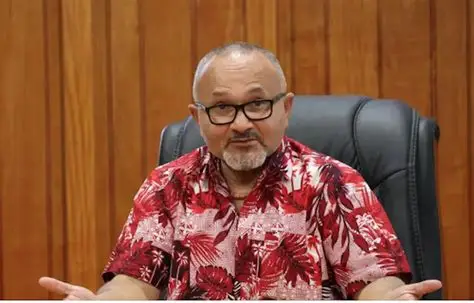
Solomon Islands Prime Minister Matthew Wale has survived an attempt to remove his government after an opposition-backed no-confidence motion was withdrawn, prompting parliament to suspend its sitting indefinitely.
The political standoff unfolded amid growing geopolitical competition between China and Western powers over influence in the Pacific island nation.
The motion was initiated by Manasseh Maelanga, who had served as home affairs minister before being dismissed as more lawmakers shifted their allegiance to Wale’s governing coalition. Maelanga withdrew the motion on Sunday after failing to secure sufficient support.
Parliament was then adjourned indefinitely on Monday, effectively preventing an immediate fresh attempt to challenge the government.
“We hope to come back before Christmas to pass the budget,” Wale told lawmakers.
“The pace of change is fast.”
Wale said the parliamentary break would provide his administration with time to consider major reforms, including changes to the mining sector and plans to introduce free education.
The political crisis has attracted close attention from China, the United States and Australia because of the Solomon Islands’ strategic position in the Pacific.
US Deputy Secretary of State Christopher Landau arrived in the country on Sunday, where he announced plans for the return of the Peace Corps. The programme has historical significance in the Solomon Islands, where US forces fought a major World War II campaign.
Wale, who was elected prime minister in May, has been moving the country towards closer relations with Australia and the United States while reassessing a security agreement signed with China in 2022.
His government is negotiating a new security treaty with Australia, has reached an agreement allowing US Coast Guard patrols and is discussing potential US investment in a port project that had previously attracted Chinese interest.
Diplomats attending the Pacific Islands Forum told AFP that the survival of Wale’s administration could have wider regional security implications, particularly as the government seeks to reduce its dependence on Beijing.
Tensions over China’s growing influence have also affected regional diplomacy, with several Pacific leaders staying away from the recent summit after Beijing objected to Taiwan’s participation.
James Batley, Australia’s former high commissioner to the Solomon Islands, said the withdrawal of the no-confidence motion would likely be welcomed by Canberra.
“I imagine that the Australian government will be very relieved,” Batley said.
He added that public opposition to an attempt to remove Wale so soon after his election would likely have been strong.
Australia has previously criticised the deployment of Chinese police personnel to the Solomon Islands under an arrangement reached during the administration of former Prime Minister Manasseh Sogavare.
Canberra is now working with Wale’s government on efforts to strengthen and train Pacific police forces.
AFP

- 2027: Atiku, Obi, Sowore lack what it takes to defeat Tinubu — Wike’s aide - October 22, 2026
- How suspect used fake NNPC documents to defraud Singaporean $285,000 - October 22, 2026
- NEC approves 90-day plan to ease hardship, lower transport costs - October 22, 2026