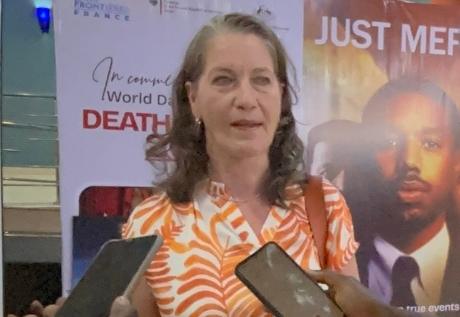
Over 3,500 Nigerians are currently awaiting execution, prompting renewed calls from human rights advocates, legal experts, and international partners for the Federal Government to abolish the death penalty.
The appeal was made in Abuja during an event marking the 2025 International Day Against the Death Penalty, jointly organised by the German Embassy, Avocats Sans Frontières (ASF) France, and the Australian High Commission.
The commemoration, observed globally every October 10, featured a screening of “Just Mercy,” a film based on the true story of Bryan Stevenson, a Harvard-trained lawyer who defends wrongly convicted individuals in Alabama, USA.
Speaking at the event, Angela Uzoma-Iwuchukwu, Country Director of ASF France, noted that Nigeria has made notable progress, having gone nine years without any execution—the last recorded case being in Edo State in 2016.
She, however, urged the government to take the next bold step by declaring an official moratorium on executions.
“We have made progress regarding the death penalty in Nigeria. One of the key achievements is that we have gone nine years without an execution. The next phase is an official moratorium that will allow for deeper legal review and reform,” she said.
Uzoma-Iwuchukwu stressed that the death penalty offers no real protection to society and is often applied disproportionately against the poor and vulnerable.
“Our clients face torture and degrading treatment because Nigeria still enforces the mandatory death penalty for certain crimes. This punishment protects no one,” she added.
German Ambassador to Nigeria, Annett Günther, reaffirmed her country’s firm opposition to capital punishment, noting that Germany abolished the death penalty decades ago and continues to advocate globally for its eradication.
“It is estimated that over 20,000 people are on death row worldwide, including about 3,500 Nigerians. Capital punishment goes beyond law—it violates human dignity and the right to life,” the ambassador said.
She added that 144 countries have already abolished the death penalty in law or practice, aligning with a growing global consensus.
Similarly, Neil Sanderson, Charge d’Affaires of the Australian High Commission, called on Nigeria to take decisive action to end the practice, describing it as “a cruel, inhumane, and ineffective punishment.”
“Australia’s position is clear — we oppose the death penalty in all cases and continue to advocate for its global abolition,” Sanderson stated.
The Executive Secretary of the National Human Rights Commission (NHRC), Tony Ojukwu, described the year’s theme, “The Death Penalty Protects No One: Abolish It Now,” as timely and consistent with the commission’s mission to safeguard the right to life.
He warned that judicial errors in capital punishment cases could lead to irreversible consequences.
“The death penalty is final and leaves no room for correction if a mistake is made. Justice should never come at the cost of life,” Ojukwu cautioned.
President of the Nigerian Bar Association (NBA), Afam Josiah Osigwe, also echoed the sentiment, stressing that courts are not infallible and that the irreversible nature of the death penalty makes it incompatible with a fair justice system.
The event concluded with a collective call for Nigeria to join the growing number of nations abolishing capital punishment, replacing it with more humane and reformative justice measures.

- Oyo moves to clean up markets with new public toilet initiative - March 15, 2026
- Kaduna’s 36km Bagoma–Gagumi road to surpass Uba Sani’s previous record — KADRA MD - March 15, 2026
- SERAP urges Tinubu to probe ₦5.9bn spent on NNPC rebranding - March 15, 2026