In Nigeria, weddings are far more than glamorous celebrations.
They form a massive, largely informal economic engine that quietly contributes hundreds of billions of naira to national productivity each year.
Beneath the music, décor and fashion is what industry experts call Nigeria’s “hidden GDP,” sustained by thousands of small businesses and service providers who rely on weddings for their livelihoods.

A 2023 report by the National Bureau of Statistics (NBS) shows that the creative and event services sector — which includes weddings — contributes about 2.3% to Nigeria’s GDP, amounting to nearly ₦5 trillion annually.
Analysts say weddings alone represent an estimated ₦1.2 trillion of that figure when the full value chain is taken into account, ranging from catering and décor to logistics, photography, music, and fashion.
The 2024 Event Industry Conference Report (EICR) notes that a typical mid-scale wedding in Lagos costs between ₦15 million and ₦25 million, with Abuja and Port Harcourt recording similarly high expenditures.
Luxury ceremonies can easily exceed ₦80 million, while smaller weddings across regional cities still inject between ₦1 million and ₦5 million into local economies.
With more than 20,000 weddings held across Nigeria every year, the sector provides over 500,000 direct and indirect jobs to planners, tailors, caterers, bakers, makeup artists, drivers, MCs, and digital content creators.
The Association of Event Vendors of Nigeria (ASEVEN) describes the wedding industry as the fastest-growing informal employer of Nigerian youth and women.
This is largely because over 80% of wedding-related enterprises operate outside formal business registration, according to the SMEDAN/NBS MSME Survey (2022).
These small businesses depend heavily on referrals and social media platforms rather than traditional advertising.
Instagram and TikTok have become essential marketing tools for service providers.
The Digital Economy and Society Index (DESI 2024) indicates that more than 65% of Nigeria’s creative SMEs secure their clients through social media, with weddings being the most shared and documented event type in West Africa.
This digital visibility fuels constant demand for decorators, photographers, fashion designers, DJs, and event planners.
Several sub-sectors have grown significantly as a result.
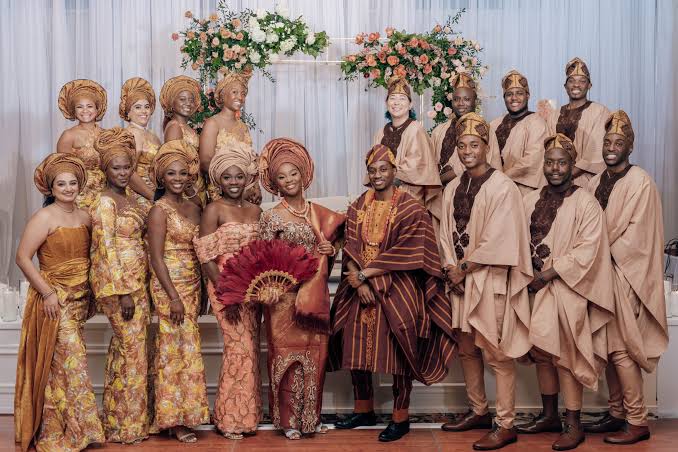
The aso-ebi and fashion segment generates an estimated ₦250 billion annually through fabric sales, tailoring and embroidery, while the catering sector records roughly ₦400 billion each year, driven largely by weddings, according to the Culinary Federation of Nigeria.
Even the financial sector benefits, as microfinance institutions now issue more than ₦80 billion annually in wedding-related loans, based on the National Microfinance Policy Review (2024).
In Lagos, hotel bookings tied to weddings contribute about ₦7 billion every year to the hospitality industry.
Experts say the strength of this economy lies in Nigeria’s cultural expectations around marriage.
Weddings serve as public expressions of identity, status and family pride — what sociologists refer to as the “economy of celebration.”
This cultural drive ensures a steady flow of spending and sustains businesses across hospitality, transport, fashion, catering and entertainment.
Yet despite its influence, the sector remains largely unrecognised in government planning. Most states do not include event services in their formal development strategies.
The Lagos Creative Economy Policy Draft (2024) suggests that formalising just 30% of the wedding value chain could inject up to ₦150 billion in taxable income into the state’s economy within three years.
As BusinessDay reports, behind every colourful aso-ebi, grand entrance and viral wedding video lies a complex network of economic activity.
Nigeria’s wedding industry is not merely about celebration; it is a powerful, resilient private-sector engine that shows how culture can drive commerce and quietly sustain millions.

- Lagos industrial estate engulfed in Fire - January 24, 2026
- TikToker Peller joins Lagos varsity to study law - January 24, 2026
- Banker chooses jail in ₦1.5bn bank error case - January 24, 2026