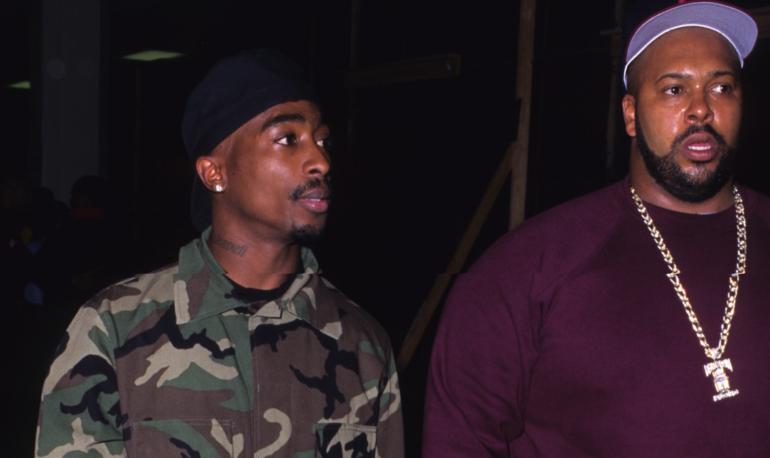
Former Death Row Records executive Suge Knight has claimed that the ashes of late American rapper Tupac Shakur were rolled into blunts and smoked by people close to him after his death.
Knight made the revelation while discussing the aftermath of Tupac’s fatal shooting in Las Vegas in 1996.
Tupac was shot during a drive-by attack and died six days later after being placed on life support. Knight was in the vehicle with the rapper when the shooting occurred.

According to Knight, Tupac’s mother requested that the rapper be cremated following his death.
He said he initially contacted a funeral home worker to arrange the cremation, but the individual rejected the request. After several attempts, Knight said he eventually visited the worker at his home and offered him $200,000 as well as $1 million in cash.
Knight said Tupac’s ashes were later collected and taken to a hotel in Las Vegas where the rapper’s mother had gathered friends and associates.
He claimed that the ashes were rolled into several blunts and smoked by those present.
Knight said he did not participate because he was on probation and feared that smoking could violate the conditions of his release.
The revelation comes as the trial of Duane “Keffe D” Davis, a former Los Angeles-area gang leader accused of orchestrating Tupac’s killing, gets underway in Las Vegas.
Davis, who was arrested in September 2024, has pleaded not guilty to a murder charge involving the use of a deadly weapon in connection with gang activity.
Nearly three decades after the shooting, prosecutors have accused Davis of helping facilitate the attack following an earlier confrontation involving Orlando “Baby Lane” Anderson, his nephew.
During the trial, prosecutor Binu Palal told jurors that Davis had a strong motive to retaliate against Tupac after the earlier assault on Anderson.
Palal alleged that Davis obtained a gun and handed it to Anderson, who subsequently opened fire on Tupac’s vehicle in Las Vegas.
The prosecutor also argued that the case remained unsolved for years because of the culture of silence surrounding gang activity.
“Silence means survival” in the gang world, Palal argued, adding that Davis was the person who eventually struggled to maintain that silence.
The prosecution is expected to rely partly on Davis’ previous interviews and a book in which he allegedly discussed his involvement in events surrounding the killing.
Davis’ defence lawyer, Michael Sanft, however, challenged the prosecution’s account, accusing it of presenting “fictional details as fact.”
Sanft also questioned the police investigation, alleging that key investigative records were missing and accusing law enforcement agencies involved in the case of misconduct and incompetence.
He specifically raised concerns about the handling and testing of the alleged murder weapon, claiming that the Los Angeles Police Department provided Detective Long with a “fake” gun for testing.
The defence lawyer also criticised another investigator, identified as Clifford Mogg, describing his work as “biased, sloppy and incomplete” and alleging that he failed to properly document information received about the murder.
Sanft further attacked the credibility of prosecution witnesses, describing them as unreliable individuals with criminal records, financial incentives and conflicting accounts.
The trial is taking place almost 30 years after Tupac was fatally shot, with the court expected to hear competing accounts of the events that led to one of hip-hop’s most enduring unsolved killings.

- APC mocks Obi over claim of victory without evidence - October 9, 2026
- Nigerian Army graduates new Special Forces battalion to tackle terrorism - October 9, 2026
- Court remands terrorist over 170 AK-47 rounds in Kuje prison - October 9, 2026