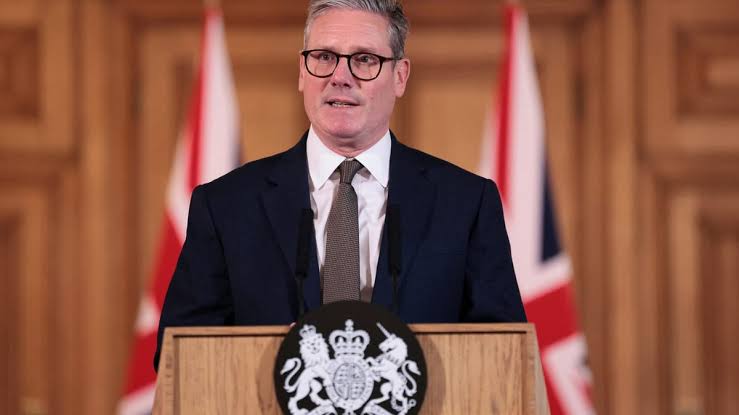
British Prime Minister Keir Starmer has officially announced his resignation.
Starmer announced his departure during a press conference at Downing Street in London on Monday, June 22, 2026.
He promised to do everything he could to see an orderly transfer of power and would give his successor his full support.

He said nominations for anyone to replace him would open on July 9. However, his rival Andy Burnham is the clear frontrunner.
Starmer said: “The question my party is asking now is whether I am best placed to lead us into the next general election, I have heard the answer of my parliamentary party to that question, and I accept that answer with good grace.
“Every decision I have taken has been about putting the country I love first. That is why I will resign as leader of the Labour Party.”
Starmer thanked his colleagues for their support, his voice cracking with emotion as he also paid tribute to his wife and children.
He added that when he left the biggest job in British politics, he would spend his time on the most important job, which was to be the best husband to his “fantastic wife”, Victoria, and the best father to his “beautiful children”.
The threat to Starmer, which had been building for months, increased sharply on Friday when Burnham, the Greater Manchester mayor, decisively won a parliamentary election to return to Westminster, beating a candidate from Nigel Farage’s Reform UK party, which has led national opinion polls for more than a year.
That victory gave hope to Labour lawmakers that Burnham, a career politician known for his communication skills, could transform the fortunes of a party that has lost support under Starmer, whose popularity ratings have sunk to the lowest for any British leader.
Oil prices fall as US, Iran end talks in Switzerland
Starmer became British prime minister in 2024 following his party’s landslide victory in a parliamentary election.
The 63-year-old entered power with one of the longest lists of problems ever to face an incoming leader and few resources to deal with them.
The former lawyer turned to politics in his 50s in a career that has been marked by a cautious and methodical approach.
As a barrister, he often defended underdogs and worked to get people off death row around the world.
He became a Labour lawmaker in 2015, a year after he received a knighthood for his services to law and criminal justice.
Starmer was appointed Labour leader in 2020 following the party’s worst election showing since 1935.

- NSA phone-tapping: El-Rufai knows fate October 26 - September 22, 2026
- Mambilla deal: Malami rejects bribery finding, demands full disclosure of ICC record - September 22, 2026
- UNICAL suspends 9 students over exam misconduct - September 22, 2026