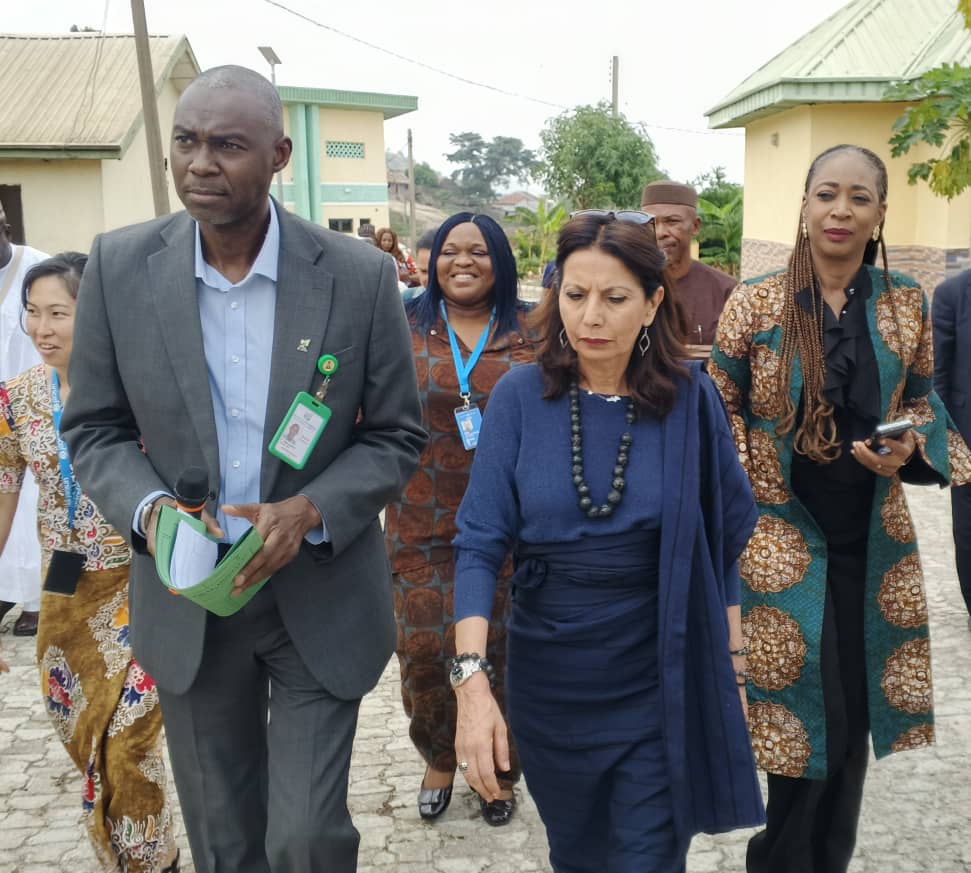
The United Nations has commended the Federal Capital Territory Administration (FCTA) for its multisectoral approach to ending all forms of Sexual and Gender-Based Violence (SGBV).
The Special Representative of the UN Secretary-General on Violence against Children, Dr Najat M’jid, gave the commendation when she visited the Awyetu Sexual Assault Referral Centre (SARC) in Abuja on Tuesday, May 6, 2025.
The SARC, located at Bwari General Hospital, was established in 2020 by the British Council on behalf of the European Union under its Rule of Law and Anticorruption (ROLAC) Programme.

The centre was established to provide comprehensive medical, psychological, and legal support to survivors of sexual violence, with a special focus on children and vulnerable populations.
M’jid expressed excitement with the synergy among the different sectors working together to eliminate all forms of SGBV in the FCT.
She said: “I am happy today because of what I have seen – many ministries are onboard supporting the fight against SGBV.
FCTA orders demolition of 24 storey buildings built on waterway
“This is because the problem is not only the problem of FCT Women Affairs; the issues are also in health, in Justice, and in communities.”
The UN official stated that she is in Nigeria to understand what was being done to address SGBV, “and how together, we can move forward”.
M’jid added that Nigeria is one of the path-finding countries on ending violence against children.
M’jid noted that the country has also been involved and very committed to ending all forms of violence against children and has made pledges.
The UN special representative, however, stressed the need to address the drivers of SGBV, detect, and respond to reported cases and ensure that it was not happening again.
She added: “It is really important to make sure that the victims can be heard, be considered and be seen as victims and make the perpetrators accountable.
“There is also the need to stop justifying violence against children and women through poverty and through social norms”.
Also speaking, the Mandate Secretary of the FCT Women Affairs Secretariat, Adebayo Benjamins-Laniyi, said a multisectoral problem required a multisectoral approach to tackle it.
Benjamins-Laniyi stated that a stronger synergy was required among critical stakeholders to deliver critical intervention from the local to the state level, in line with global best practices.
She described M’jid’s visit as a “positive disruption” that sparked a desire to strengthen partnership and collaboration among the different stakeholders to do more for women and children in the FCT.

- Tinubu to celebrate 74th birthday ‘low key’, reaffirms commitment to Nigeria’s growth - March 29, 2026
- Edo govt raises varsity’s monthly subvention to N250m - March 29, 2026
- Israeli strike kills three journalists in Lebanon - March 29, 2026