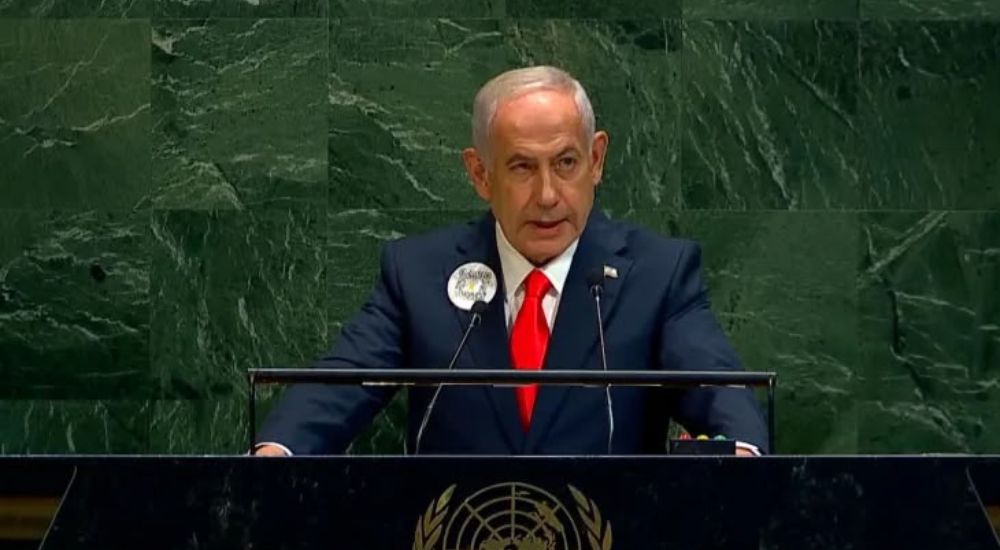
Dozens of delegates walked out of the United Nations General Assembly hall on Thursday as Israeli Prime Minister Benjamin Netanyahu took the podium to address the 81st session of the assembly in New York.
The walkout came amid international criticism of Israel’s military operations in Gaza and its wider conflict with Iran.
As Netanyahu began speaking, several delegations left the chamber, while supporters in the public gallery applauded and chanted in his support. The presiding officer repeatedly called for order.

Netanyahu proceeded with his address and strongly defended Israel’s military action against Iran, particularly strikes on the country’s nuclear facilities.
“Devastating Iran’s nuclear facilities was hard. It was very hard to do. But for me, it was one of the easiest decisions I’ve ever had to make as prime minister,” Netanyahu said.
“Because if we hadn’t done it, we’d all be dead,” he added.
He said he had pledged years ago to prevent Iran from acquiring nuclear weapons and maintained that Israel’s military campaign had achieved that objective.
“14 years ago, I vowed to prevent Iran’s murderous dictatorship from developing atomic bombs. That’s exactly what we did,” he said.
Netanyahu also argued that Israel’s military actions had benefited other countries, including some whose representatives had left the chamber.
“Israel is also defending many of the countries whose delegates just left this hall,” he said.
He further claimed that foreign leaders had privately expressed appreciation for Israel’s action against Iran’s nuclear programme.
Netanyahu also criticised those who walked out, calling on any remaining “moral cowards” to leave the chamber.
The Israeli prime minister’s appearance came amid heightened diplomatic pressure over Israel’s military operations in Gaza and the wider Middle East conflict. His visit to New York also took place against strained relations with some traditional partners.
Iran has consistently rejected claims that it is seeking to develop nuclear weapons, maintaining that its nuclear programme is intended for peaceful purposes.
Netanyahu, however, has continued to argue that military action was necessary to prevent Tehran from acquiring nuclear weapons.

- UNGA 81: Delegates walk out as Netanyahu takes podium - September 24, 2026
- Ghanaian lawmaker collapses while delivering speech - September 24, 2026
- Dangote, Ethiopia, Djibouti plan $660m petroleum pipeline - September 24, 2026