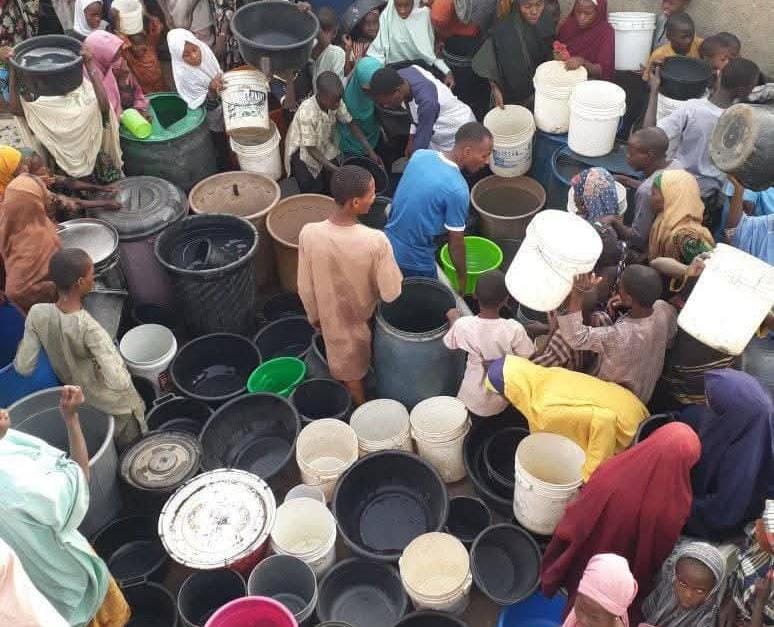
Residents of Kano State continue to endure severe water scarcity, with a gallon of water selling for as high as N200 in many parts of the city.
The situation has forced people to trek long distances in search of water.
Despite various interventions by the Kano State Government, efforts to address the persistent water scarcity have not yielded the desired results.
The worst-hit LGAs include Kumbotso, Dala, Fagge, Gwale, Kano Municipal, Kumbotso, Tarauni, Nassarawa, and Ungogo.
Many residents in these areas rely heavily on the State Water Board, government-established boreholes, private donors, and commercial water vendors for their daily water needs.
Tragedy in Kano: Woman kills husband 9 days after wedding
Water vendors, known locally as Mai Ruwa, have taken advantage of the crisis by hiking their prices by as much as 300 per jerrycan, exacerbating the hardship faced by residents.
Some residents who spoke to The Star expressed frustration, saying that while vendors profit from the crisis, they are left to suffer with little support from the authorities.
Usman Abubakar, a resident of Dandago in Gwale LGA, lamented that his community has endured acute water scarcity for 15 years. He spends between N1,500 and N2,000 daily on water, totaling over N70,000 monthly.
Another resident, Musa Inuwa from Bachirawa in Ungogo LGA, said the water shortage has affected daily life and economic activities, urging the government to find a lasting solution.
*Some state’s expenditure on water supply*
In April 2025, the Kano State Executive Council approved N1.7 billion to settle utility bills, including electricity, diesel, and petrol, for major water facilities such as the Greater Kano Water Works and the State Water Board.
Additionally, the French Development Agency (AFD) in 2023 provided N28.45 billion (€64.75 million) to support the Kano Water Project, highlighting the scale of investment in the sector.
In 2018, a partnership between the Federal Ministry of Water Resources and the Kano State Government under the PEWASH program allocated N12.7 billion to enhance rural water supply.
Despite these substantial investments, access to water remains a major challenge in many communities, leading to questions about the effectiveness of these initiatives.
*Commissioner reacts*
Commissioner for Water Resources, Umar Doguwa, attributed some of the challenges to rampant vandalism and theft of water infrastructure, which has cost the state billions in damages.
He stated that reviving the Chalawa Water Works alone would require over $3.5 million, noting that vital equipment and pipes have been stolen and are no longer available on the market.
Doguwa further explained that Kano metropolis requires 700 million cubic liters of water daily, but currently receives only 300 million, which is far below the demand.
Even with full restoration of all water plants, including those at Tamburawa and other sites, only 500 million cubic liters per day could be produced—still not enough to meet residents’ needs.
The Managing Director of the State Water Board, Engr. Garba Ahmed, revealed that the Chalawa Water Works, built in 1930, operated efficiently until 2016, after which it was looted and abandoned during the previous administration.
The Star

- Troops foil oil well vandalism plot in Anambra - March 29, 2026
- APC hails Tinubu at 74, defends reforms as ‘bold, transformative’ - March 29, 2026
- I battled depression while signed to Davido’s record label — Liya - March 29, 2026