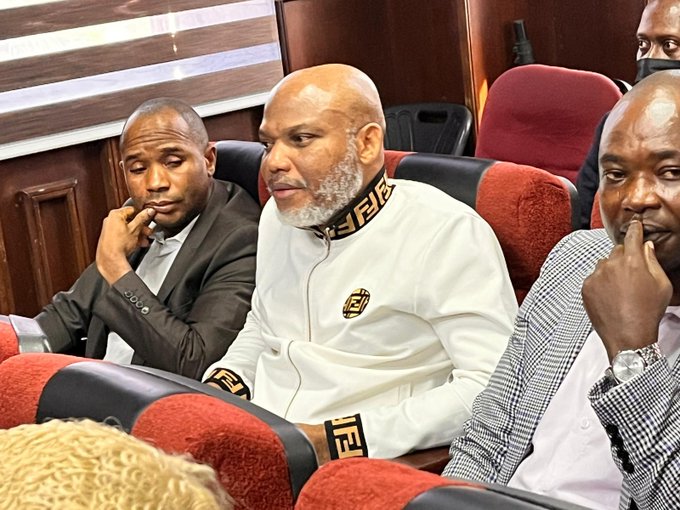

Fresh insights have emerged on the circumstances surrounding the arrest and continued prosecution of Nnamdi Kanu, leader of the proscribed Indigenous People of Biafra (IPOB), following a landmark judgment delivered today by the Federal High Court in Abuja.
Kanu, who has long been at the centre of separatist agitation in the South-East, was first arrested in October 2015 by the Department of State Services (DSS) on allegations of treasonable felony, unlawful possession of firearms, and incitement.
His arrest stemmed from a series of public speeches and broadcasts in which he repeatedly advocated the secession of the South-East to form an independent Biafra Republic.
He was granted bail in April 2017 but fled Nigeria months later after a military raid on his family home in Afaraukwu, Abia State.
From abroad, Kanu continued his broadcasts via Radio Biafra, where the Nigerian government claimed he intensified rhetoric that promoted violence, civil disobedience, and attacks on security agencies.
In June 2021, he was re-arrested in a controversial international operation coordinated by Nigerian security agencies and foreign partners.
He was subsequently returned to Nigeria and arraigned on amended terrorism and treason-related charges.
The Federal Government accused him of using his broadcasts to mobilise assaults on security operatives and government facilities in the South-East.
Prosecutors also linked activities of the Eastern Security Network (ESN), believed to be IPOB’s armed wing, to directives they alleged were issued by Kanu.
His legal team, however, insisted he merely advocated self-determination and never encouraged violence.
The long-running case reached a turning point today when Justice James Omotosho of the Federal High Court convicted Kanu on all seven terrorism-related counts filed against him.
The court imposed a life sentence on counts one, two, four, five, and six; 20 years without the option of a fine on count three; and five years without the option of a fine on count seven.
The judge ruled that Kanu’s broadcasts—tendered as evidence—contained inciting messages that contributed to unrest in the South-East.
He held that Kanu’s actions amounted to terrorism under Nigerian law.
The verdict has sparked widespread reactions across the country.
While government supporters view the ruling as a victory for national security, IPOB members and many others in the South-East say the judgment is unjust and politically motivated.
Kanu’s former lawyer and consultant, Aloy Ejimakor, has already announced that the defence team will head to the Court of Appeal, insisting that the conviction “will not stand.”
Kanu’s arrest, re-arrest, and now conviction have become a defining chapter in Nigeria’s struggle with separatist demands, regional grievances, and national security concerns.
Supporters see him as a symbol of resistance against marginalisation, while critics argue his rhetoric helped inflame violence in a region already troubled by insecurity.
With the case now expected to proceed to the appellate courts, Nnamdi Kanu’s legal and political journey continues to shape conversations about justice, governance, and the future unity of Nigeria.

- Court to rule April 14 on $35m NCDMB document in Akintoye’s trial - March 11, 2026
- Court sentences two for online impersonation, fraud - March 11, 2026
- “PDP will never die” – Wike insists on genuine reconciliation - March 11, 2026