

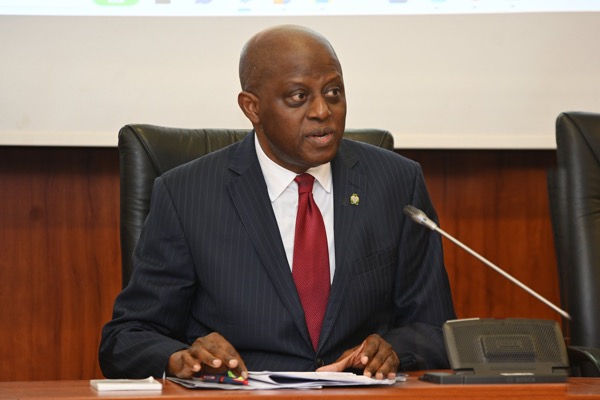
The Central Bank of Nigeria (CBN) has begun adopting Artificial Intelligence (AI) tools to enhance monetary policy forecasting and decision-making, according to the CBN Governor, Dr. Yemi Cardoso.
Cardoso disclosed this during a fireside chat at the London Business School, moderated by Prof. Hélène Rey, Lord Bagri Professor of Economics.
He said the integration of AI marks a significant step in improving the accuracy and responsiveness of the Bank’s monetary policy framework.
“AI has been adopted in monetary policy, particularly with forecasting,” Cardoso said, underscoring the growing importance of technology in shaping economic and financial management.
Responding to questions on cryptocurrency, the CBN Governor noted that the Bank recognises its relevance to young Nigerians and hinted that a new policy direction on digital assets would be announced soon.
On interest rates, Cardoso acknowledged that current rates remain high but expressed optimism that they would moderate as macroeconomic conditions improve.
He added that with arbitrage opportunities now eliminated, banks would be compelled to focus more on genuine business generation and lending activities.
Speaking on the ongoing bank recapitalisation exercise, Cardoso reaffirmed that institutions unable to meet new capital requirements have the option to merge or downgrade their licences, noting that sufficient time has been provided for compliance.
He dismissed speculation about any deadline extension, stressing there is no cause for panic.
Addressing concerns about the bond market, Cardoso clarified that the CBN’s recent interventions were aimed at ensuring price discovery and transparency, similar to reforms in the foreign exchange market.
“It’s about improving market efficiency and allowing participants to operate within their licence categories,” he explained.
The CBN Governor also reflected on Nigeria’s economic reforms, saying many of the current challenges could have been avoided had critical policy changes been implemented earlier.
“Reforms that should have been done a decade ago were neglected. The fuel subsidy was unsustainable, and the foreign exchange situation had reached a crisis point,” he said.
Cardoso emphasised that his primary mandate as CBN Governor is to ensure price and foreign exchange stability, not necessarily to drive economic growth, which falls under the broader responsibility of the fiscal authorities.

- PDP replaces Kano gov candidate with Abacha’s son - September 16, 2026
- FG rules out fee hike under King’s College deal - September 16, 2026
- Power minister: Nigerians ask me to slow down, freezers are freezing - September 16, 2026