The quiet but intense struggle for political power ahead of the 2027 general election is reshaping alliances and rivalries across Northern Nigeria.
Support and opposition to President Bola Ahmed Tinubu’s second-term ambition have become a major fault line in the region’s politics.
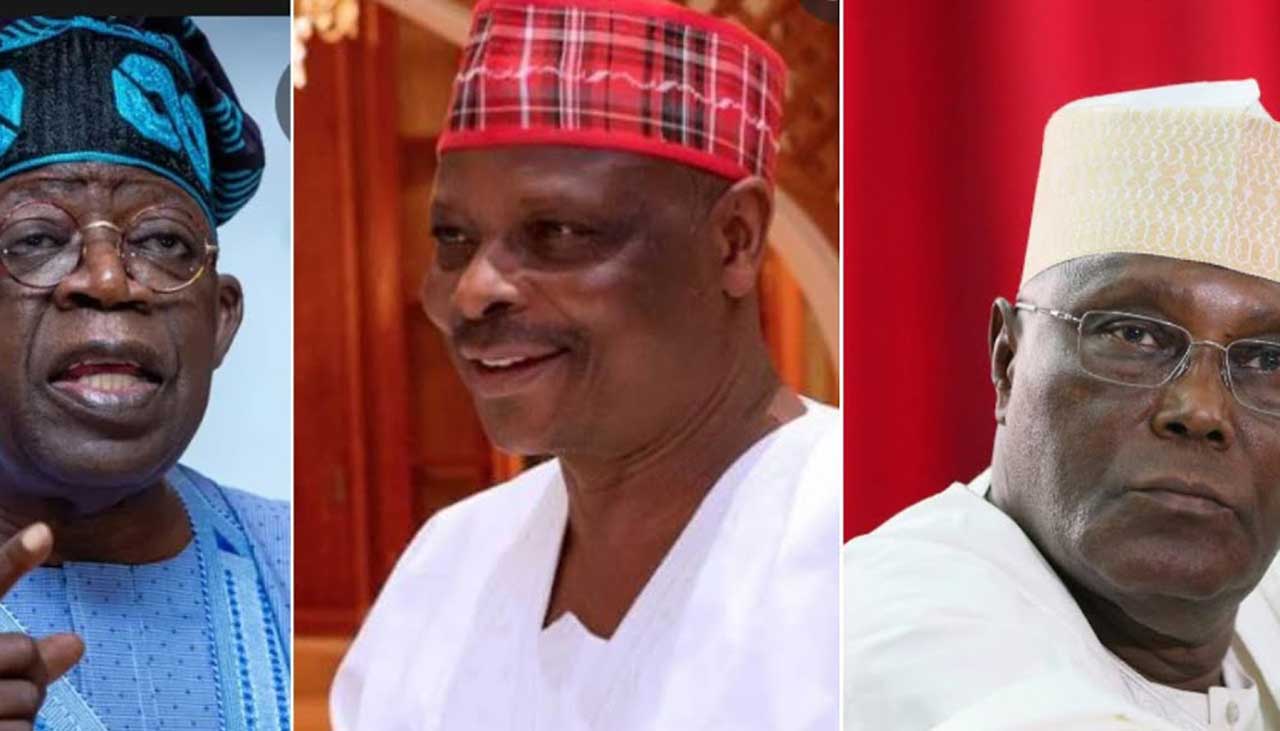
At the centre of this evolving contest are President Tinubu, former Vice President Atiku Abubakar, and former Kano State governor, Senator Rabiu Musa Kwankwaso.
Each is positioning for influence in a region that holds the key to national victory.
For Atiku, who has contested repeatedly for the presidency, the North remains his best political asset.
But his dominance now faces serious challenge from Kwankwaso, whose Kwankwasiyya movement and control of the New Nigeria Peoples Party (NNPP) government in Kano give him a unique edge.
Kwankwaso’s confidence rests on his firm grip on Kano, the North’s largest voting bloc.
Since his protégé, Governor Abba Kabir Yusuf, reclaimed power in 2023, the state has been a hotbed of political confrontation, marked by the dethronement of Emir Aminu Ado Bayero and the reinstatement of Muhammadu Sanusi II.
Although Kwankwaso briefly appeared to warm up to Tinubu after the 2023 election, their relationship soon turned cold.
The appointment of his longtime rival, Abdullahi Ganduje, as APC national chairman sent a clear signal that Tinubu preferred to keep him at arm’s length.
Still, Tinubu has not given up on courting the region. With incumbency on his side, he counts on loyal governors in Katsina, Kaduna, and Jigawa — Dikko Radda, Uba Sani, and Umar Namadi — to deliver the North-West.
In the North-East, Governor Mai Mala Buni of Yobe remains firmly aligned with the President, while Borno’s Babagana Zulum continues to stand by Vice President Kashim Shettima.
Yet the growing opposition among northern elites, including Atiku and former Kaduna governor Nasir el-Rufai, signals that Tinubu’s re-election path may not be smooth.
The Kano Emirate tussle deepened the rift between the Presidency and the NNPP. While Governor Yusuf backed Sanusi’s reinstatement, Ganduje and Abuja were seen to support Bayero’s resistance.
Ganduje’s eventual removal as APC chairman was widely interpreted as an attempt to appease Kwankwaso, but the NNPP leader’s ambivalence has only fuelled more uncertainty.
The suspension of Abdulmumin Jibrin from NNPP after his visit to Tinubu further exposed internal cracks and the growing exhaustion with Kwankwaso’s shifting loyalties.
Atiku, meanwhile, faces a tougher terrain. Despite his name recognition, he no longer controls any state directly.
In Adamawa, Governor Ahmadu Fintiri has become politically independent, while Kebbi and Taraba remain unpredictable. Without a solid power base in the region, Atiku’s influence appears to be waning ahead of 2027.
Ganduje, on the other hand, has struggled to stay relevant after his removal as APC chairman.
At a recent public event in Kano, he lamented that his successor had abandoned projects and programmes initiated under his administration, a statement that drew reminders of how he had also discarded Kwankwaso’s projects when he took office.
Across the North, the rivalry among Tinubu, Atiku, and Kwankwaso is redefining old alliances and shaping new ones.
With Tinubu relying on loyal governors, Atiku seeking fresh openings, and Kwankwaso leveraging Kano’s political weight, the battle for the northern vote is intensifying.
As the 2027 race gathers pace, identity politics, ambition, and shifting loyalties continue to blur the lines between friendship and rivalry.
One thing, however, remains certain: the contest for the northern pie will once again determine who rules Nigeria.

- Tinubu hails ICC tribunal verdict rejecting $680m Sunrise Power claim against Nigeria - September 17, 2026
- I’ll retire from politics after 2031 — Otti - September 17, 2026
- 2027: Obi-Kwankwaso movement unveils 59-member campaign council - September 17, 2026