

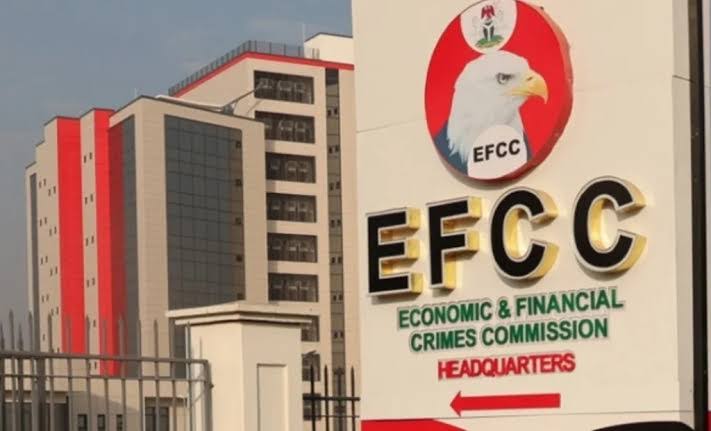
The Economic and Financial Crimes Commission has raised the alarm over a growing pattern in which suspected public funds are transferred from government accounts to private companies and subsequently moved into cryptocurrency wallets.
EFCC Chairman, Ola Olukoyede, disclosed this on Monday while speaking with media executives and journalists in Abuja, saying the commission had intervened in one such transaction after its internal monitoring system flagged the movement as suspicious.
Olukoyede did not identify the local government, company or state connected to the transaction.
He said the commission’s Fraud Risk Assessment and Control Department detected the movement and ordered a temporary 72-hour freeze on the account to establish the purpose and destination of the funds.
According to him, investigators traced the money from a local government account to a company and subsequently discovered that it had been transferred into cryptocurrency wallets.
“When we see money moving suspiciously, we move in and freeze it in the interim,” Olukoyede said.
He challenged critics of the action to explain why public funds were being moved through such channels.
“Okay, come and show where this money is going? Why are you moving money? We saw money being moved from the local government account to a company. Apart from that phase, we discovered that the money has gone into cryptocurrency wallets,” he said.
The EFCC chairman said the incident demonstrated why anti-corruption agencies needed to prevent suspicious financial transactions rather than wait until public funds had been completely diverted before intervening.
“Why must we be waiting for money to be stolen? Why can’t we change the narrative?” he asked.
The disclosure comes weeks after the EFCC attracted criticism over its decision to freeze an account belonging to the Osun State Government shortly before the August 15 governorship election.
Olukoyede, however, did not connect the transaction he disclosed to Osun State or any other specific state.
He also warned that the use of cryptocurrency in financial crimes had evolved beyond conventional cybercrime popularly associated with “Yahoo Yahoo”.
According to him, some public officials allegedly use young people and students as fronts to create and operate cryptocurrency wallets through which illicit funds are moved rapidly outside the country.
“We have gotten to a stage in Nigeria now that public officials steal money and they put it in cryptocurrency wallets,” he said.
Olukoyede said investigators were increasingly finding cases where officials had no easily traceable assets because allegedly stolen funds were transferred through third parties and converted into virtual assets.
He said the EFCC had developed the capacity to trace cryptocurrency wallets, particularly those connected to virtual asset service providers operating legally in Nigeria.
According to him, about 40 virtual asset platforms have been licensed as part of efforts to improve regulatory oversight of the sector.
The chairman also disclosed that the EFCC had recovered virtual assets linked to the CBEX fraud but acknowledged challenges surrounding the custody and accountability of confiscated cryptocurrency.
“When you recover virtual assets, where do you put them? No accountability. That’s why we can’t continue like this,” he said.
He said the Federal Government had approved the establishment of a national confiscation wallet where virtual assets recovered by law enforcement agencies would be deposited.
“Today, now we have a national confiscation wallet. So if I confiscate virtual assets now, it’s a national wallet that we put into those,” Olukoyede said.
He urged financial institutions and other relevant agencies to strengthen their technological capacity as criminals increasingly adopt digital assets to conceal and move illicit proceeds.
“When we are talking about cybercrime, please cooperate with us, understand the scope. Not just Yahoo,” he said.
Olukoyede further disclosed that the EFCC had recovered about N288.1bn in federal and state tax liabilities during the period under review.
The amount, he said, comprised approximately N173.2bn in federal tax recoveries and N114.9bn recovered for State Internal Revenue Services.
He also revealed that more than 40 EFCC personnel had been dismissed over alleged corruption and financial malpractice within the past two and a half to three years.
Some of the dismissed officials, he added, were already being prosecuted, while case files involving others were being prepared for legal action.

- Wike rallies Rivers monarchs for Tinubu’s re-election - October 17, 2026
- Shettima inaugurates Tinubu campaign office, says North’s support is not a blank cheque - October 17, 2026
- Okonjo-Iweala: My mother was kidnapped over $2.4bn fuel subsidy fraud probe - October 17, 2026