


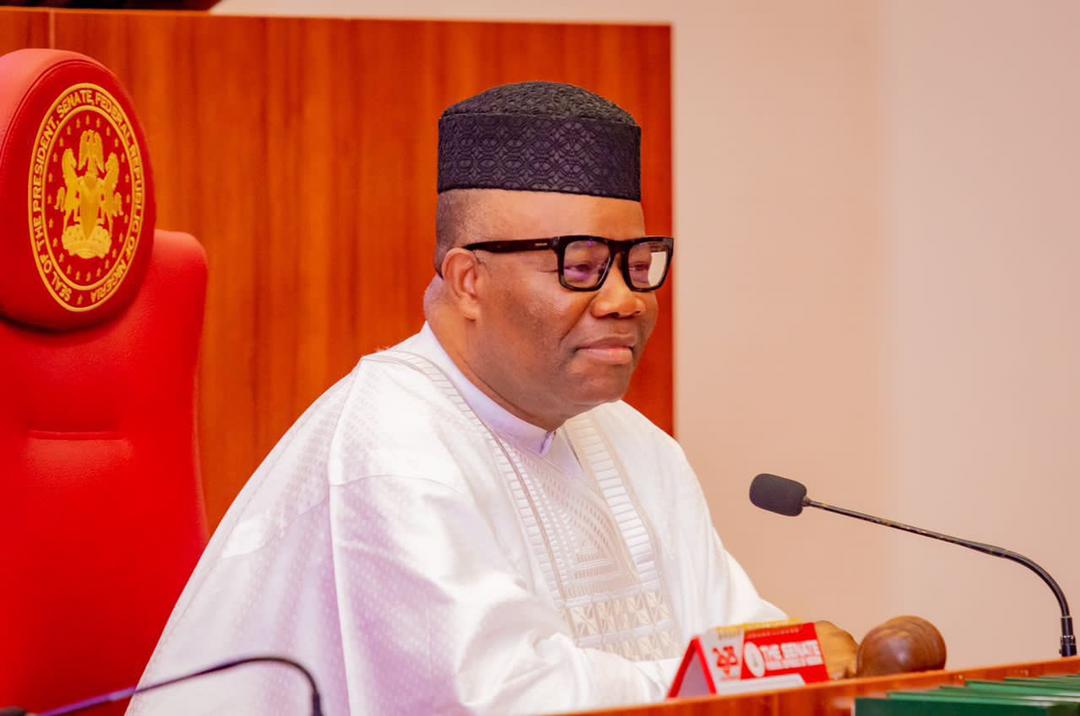
Senate President Godswill Akpabio has defended his controversial remarks that people who attempt suicide should face imprisonment if they survive, despite calls by psychiatrists for him to retract the statement and apologise.
Akpabio, who opposed a bill seeking to decriminalise attempted suicide, said comments made by lawmakers during plenary debates should not be mistaken for the Senate’s final position.
His remarks followed criticism from the Association of Psychiatrists in Nigeria, which warned that threatening suicide attempt survivors with imprisonment could deepen stigma and discourage people experiencing mental health crises from seeking help.
The association, in a statement signed by its President, Dr Veronica Nyamali, and Secretary, Prof Mayowa Okonoda, called on Akpabio to clarify or retract his reported statement and apologise to Nigerians.
Akpabio was quoted as saying during the Senate debate on October 13, 2026, “If you attempt it, you better succeed. If you don’t succeed, we will send you to prison.”
Addressing the controversy during Thursday’s plenary, the Senate President urged Nigerians to consider the outcome of legislative proceedings rather than isolate individual contributions made during debates.
“When we discuss here, we discuss for and against, and in the course of our discussions, whatever we say should not anger anybody outside this chamber, because at the end, what matters is our final decision,” he said.
He added that lawmakers must be allowed to disagree during deliberations as they work towards making laws.
“We want to make the best laws, so we are bound to oppose each other, and we are also bound to support each other,” he said.
Akpabio also cautioned television panellists and other commentators against what he described as politically motivated interpretations of legislative debates.
“No matter the discussion, please consider the final decision of the Senate. Don’t go and sit down in panels and try to do politically motivated discussions,” he added.
The Association of Psychiatrists in Nigeria, however, maintained that a person who survives a suicide attempt should be treated as someone experiencing severe psychological distress and requiring urgent medical attention, not punishment.
“The appropriate response is urgent medical care, compassionate assessment, treatment, safety planning and follow-up—not a threat of imprisonment,” the association said.
It warned that criminal penalties could discourage people at risk from seeking help, prevent families from reporting suicide attempts and delay access to emergency medical and psychiatric care.
The association urged the National Assembly to consider evidence and international public-health guidance on suicide prevention, while involving mental health professionals, survivors and human rights experts in the legislative process.
It also called for legislation to remove criminal penalties for attempted suicide and establish a funded framework for prevention, treatment, rehabilitation and continuing support.
The association cited the World Health Organisation’s 2023 policy brief, which recommended that countries identify and repeal laws criminalising suicide and attempted suicide to reduce barriers to seeking help.
It also referenced a 2008 study of 1,429 adolescents in south-west Nigeria, which found that more than one in five respondents reported suicidal ideation, while approximately 12 per cent reported a suicide attempt in the preceding year.
The psychiatrists said children and adolescents who survive suicide attempts require appropriate assessment, support and safeguarding, particularly where abuse or exploitation may be involved.
The controversy arose after Senator Asuquo Ekpenyong sponsored the Suicide Prevention Bill 2026, which seeks to decriminalise attempted suicide and provide survivors with medical treatment, rehabilitation and psychological support.
The bill proposes crisis helplines, public awareness programmes, training for police officers, teachers and health workers, and a national data system to strengthen suicide prevention.
It seeks to address what its sponsor described as inconsistencies between the National Mental Health Act, which recognises attempted suicide as a psychiatric emergency requiring intervention, and provisions of the Criminal Code and Penal Code that criminalise the act.
The proposal scaled second reading during Tuesday’s plenary and was referred to the Senate Committees on Judiciary and Health for further legislative action, including a public hearing.
During his defence, Akpabio also rejected attempts to associate terrorism with any particular religion, saying violent acts should not be used to stigmatise religious groups.
“Terrorists are not Muslims. Terrorists are not Christians. Terrorists are human beings who believe in taking their lives and the lives of others,” he said.
He maintained that discussions on suicide legislation should distinguish between people experiencing mental health challenges and those who deliberately take their own lives or kill others.
“You have to distinguish between suicide committed by people who are mentally disturbed and suicide intentionally committed by people who are physically sound,” he said.
Akpabio also cited his record of supporting Muslim and Christian pilgrims during his tenure as governor, insisting that he had no reason to speak disparagingly of Islam.
“There’s no way I will talk down on Muslim religion,” he said.
The psychiatrists maintained that public officials had a responsibility to use language that protects lives, reduces stigma and encourages people experiencing distress to seek professional help.

- Akpabio defends suicide remarks amid calls for apology - October 16, 2026
- Spaghetti deal: EFCC arraigns Kano businessman over N34.8m fraud - October 16, 2026
- Cocaine trial: KC Luxury challenges court order preserving his assets - October 16, 2026