

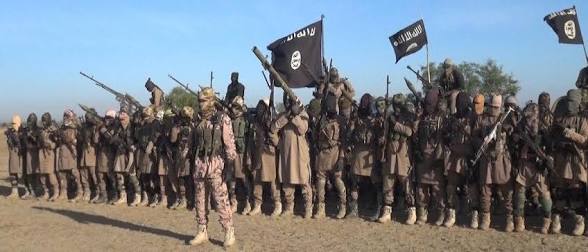
The Islamic State West Africa Province (ISWAP) pays fighters up to $30,000 for military equipment seized during attacks on Nigerian troops and military bases, using financial incentives to motivate recruitment and sustain its insurgency, a new report has revealed.
The report by the Institute for Security Studies (ISS) found that the terror group operates a reward system known as ghanimah, under which fighters surrender captured weapons to the Islamic State (IS) in exchange for fixed payments.
According to the report, an AK-47 rifle attracts $750, a rocket-propelled grenade costs $1,000, while a box of ammunition fetches between $500 and $1,000, depending on its calibre.
A pickup truck fitted with a heavy weapon is valued at $30,000.
Taiwo Adebayo, an ISS researcher and author of the report, told TheCable that the payments were made in naira and represented significant financial incentives for fighters operating in the Lake Chad Basin.
The report, titled Wiring the insurgency: Inside ISWAP’s adaptive technology programme, was released on Thursday and draws on intelligence from informants, including former fighters and early members of the Islamic State faction.
Adebayo said although the ghanimah system had existed for years, ISWAP had increasingly institutionalised it as a mechanism for motivating fighters, attracting recruits and retaining members.
He explained that former fighters told him the financial rewards helped sustain membership when religious beliefs and ideological commitment alone were insufficient.
“Ex-fighters told me that the ghanimah pricing system helped attract and keep members when faith and ideology alone were insufficient,” he said.
The report noted that ISWAP attacks on military bases had increased since 2025, with captured weapons believed to constitute the group’s biggest source of arms.
A senior Nigerian intelligence source confirmed the loss of military weapons to insurgents, describing the situation as alarming.
“At a time, it was as if we were handing weapons to ISWAP,” the source was quoted as saying.
In March, ISWAP claimed to have seized a significant stockpile of military weapons, including 54 rifles, 20 machine guns and eight heavy weapons, such as rocket-propelled grenade launchers and mortars.
The report also identified smuggling networks and financial channels through which the group obtains weapons and other equipment, including drones, satellite communication devices, boat engines and surveillance technology.
It said payments for the ghanimah system were largely funded by Islamic State’s central network in the Middle East, with money reportedly moved through currency exchange operators.
Kano and Lagos were identified as major supply hubs for equipment that insurgents cannot easily obtain locally.
According to the report, some equipment, particularly Thuraya and Starlink communication devices, is transported from Dubai in the United Arab Emirates to Kano through currency exchange networks.
From Kano, the supplies are reportedly moved through intermediaries and concealed among ordinary goods, including fabrics and food, before reaching ISWAP members through towns such as Geidam in Yobe State.
Military airstrikes kill 21 ISWAP terrorists in Borno
The group also reportedly obtains commercial equipment, including DJI Mavic drones and boat engines, from Lagos and N’Djamena.
The report further linked currency exchange operators to the supply chain, saying they facilitate payments to vendors and transfers between Islamic State and ISWAP, sometimes charging significantly above market rates.
It recalled that in 2022, the Nigeria Sanctions Committee accused 13 individuals and three companies with physical addresses in Kano of terrorism financing.
Nearly half of the individuals were currency exchange operators, some of whom had reportedly been convicted and jailed in the United Arab Emirates in 2021 for facilitating financial transactions linked to terrorism.
One of those named was Surajo Abubakar Mohammed, although the report did not establish whether he was the same person identified by interviewees as Alhaji Surajo.
It also noted that the United States imposed sanctions in June on a Nigeria-based operator accused of helping Islamic State move funds across borders through money exchange businesses.

- How ISWAP turns military raids into multimillion-naira rewards - November 28, 2026
- Low turnout, BVAS glitches mar INEC mock election in Borno - November 28, 2026
- FCC clears 2,696 Customs recruits to resume training after suspension - November 28, 2026