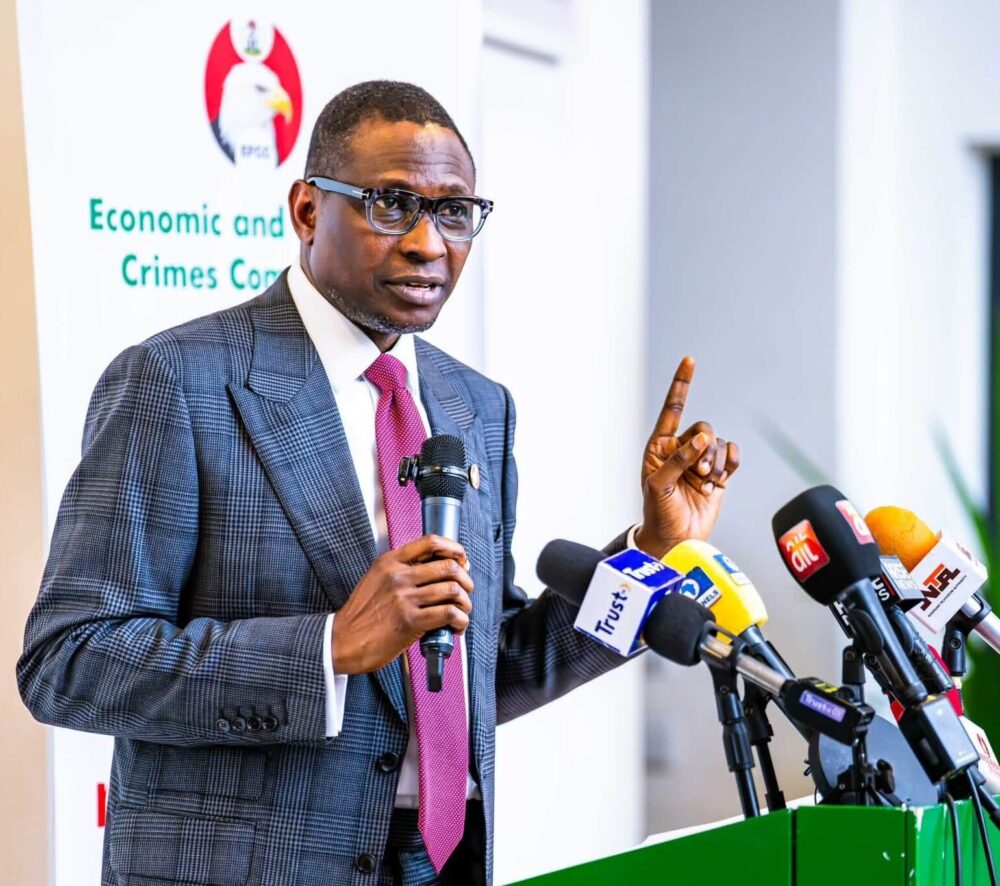
The Economic and Financial Crimes Commission (EFCC) has unveiled an interfaith manual to enlist religious leaders in the fight against corruption.
Speaking at the event held in Abuja on Wednesday, September 23, 2026, the EFCC Chairman, Ola Olukoyede, said corruption remains a profound moral challenge to Nigeria’s quest for shared prosperity.
Olukoyede emphasised that financial crime has no religious or ethnic colouration, saying: “Christianity and Islam can retain their distinctive beliefs and traditions while their adherents work together for peace, justice, human dignity and the wellbeing of our nation.
“We are a deeply religious people. Our churches and mosques are full… Yet, we must have the courage to ask ourselves: has the depth of our religious profession been sufficiently reflected in the integrity of our public and economic life?
“We (EFCC) are a law-enforcement agency, but when we examine the consequences of corruption, fraud and economic crime, we quickly discover that our work touches the very conditions that make human flourishing possible.”
The EFCC boss illustrated the human cost of graft, saying: “When money meant for a hospital is stolen, the offence may be recorded as corruption, but its consequence may be a patient who cannot receive treatment.
“When education funds are diverted, the financial crime becomes a child without opportunity.
“When pension funds are stolen, corruption becomes an elderly Nigerian deprived of dignity after a lifetime of service.”
According to him, corruption privatises what should be shared and allows one person to flourish by making many others poorer, hence the EFCC’s role is to defend the integrity of the commonwealth.
Olukoyede said to play that role effectively, the EFCC had been engaging religious leaders through its Inter-Faith framework, because “no religion condones corruption and no faith entertains fraudulent engagements.”
Olukoyede announced that the EFCC had designed an interfaith Manual to address topical anti-corruption issues for preaching.
He said: “We are using this opportunity to launch the manual, which we hope our religious leaders will surely find useful in teaching anti-corruption messages to their members.
“The EFCC believes that financial crime has no religion. Corruption has no tribe. Fraud does not become Christian or Muslim because of the identity of the person accused of committing it.
“When public money is stolen, both Christians and Muslims suffer. A badly equipped hospital does not first ask a dying patient where he worships.
“A collapsed road does not distinguish between a Christian traveller and a Muslim traveller.”
Olukoyede, who urged religious leaders to restore the moral dignity of honest living, warned that no faith community should provide moral shelter for corruption.
The event had in attendance the Secretary to the Government of the Federation, George Akume; the Sultan of Sokoto, Sa’ad Abubakar; the Nigeria Inter-Religious Council (NIREC) Executive Secretary, Prof. Cornelius Omonokhua; among others.

- EFCC unveils interfaith manual, says corruption has no religion - September 23, 2026
- Sultan to politicians: Don’t sponsor pilgrims with stolen funds, God doesn’t accept corrupt offerings - September 23, 2026
- How I manage Davido’s wealth, spending ― Sister - September 23, 2026