

Former Kaduna State Governor Nasir El-Rufai has revoked his claims that the telephone conversations of the National Security Adviser (NSA), Nuhu Ribadu, were tapped.
El-rufai, who admitted that his remark was not factual, said it was a political rhetoric meant to make those in government uncomfortable.
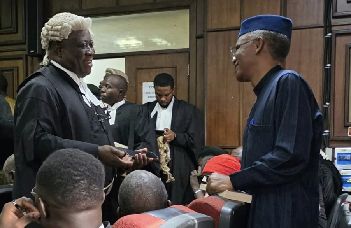
The former governor spoke when he opened his defence before the Federal High Court in Abuja in the ongoing case filed against him by the Department of State Services (DSS).
El-Rufai, in an interview on Arise Television on February 13, 2026, said he knew that the government placed surveillance on leading opposition figures, past presidents, and senior judges, among others.
The former govenor, who accused Ribadu of ordering his attempted arrest, said he knew about the directive because they had listened to a telephone conversation in which the NSA instructed security operatives to arrest him.
When asked how he obtained the information during the interview, El-Rufai said: “He made the call because we listen to their calls.”
He, however, acknowledged that intercepting telephone conversations without authorisation was illegal.
Led in evidence on Wednesday by his lawyer, Paul Erokoro (SAN), El-Rufai stated that he chose to claim that someone tapped Ribadu’s phone to create the impression that the opposition figures were equally monitoring those in government.
While El-Rufai was giving his testimony, Erokoro at a point sought the court order to have part of the recorded interview he granted to the TV station played in open court.
After listening to the interview, Erokoro asked El-rufai to clarify what he actually meant by the statement, following which El-Rufai admitted claiming that they were listening to the NSA and others’ conversations and that someone tapped Ribadu’s phone and relayed his conversations to them.
He, however, said he did not intend the statements to be taken in their literal sense, saying they were intended in “the context of literal flourish and in rhetorical form.”
The former governor added that it was political rhetoric that is allowed in political speaking.
El-Rufai said: “What I wanted to say was that the government was monitoring opposition figures and that we knew what they were doing.
“I used the word ‘tap’ as political rhetoric to make them uncomfortable. It was rhetorical, not literal. It was linguistic flourish, just to make the government uncomfortable.”
When reminded by Erokoro that his interviewer told him that it was illegal to tap someone’s phone, he said his intention was to make it public that the government was secretly listening to opposition figures’ conversations without lawful court orders.
“I was referring to the government violating the law and not someone else doing it,” El-Rufai said.
2027: Saraki alleges plot to intimidate Kwara monarchs hosting PDP
Earlier, he told the court that he knew Ribadu since 2003 when he, as the head of the Bureau of Public Enterprises (BPE), assisted him to establish the EFCC by providing office space and funds.
El-Rufai said the breakdown in their relationship came when he (Ribadu) ran for the presidency in 2011 and he felt Buhari was a better candidate.
He added that the NSA was against him because he was opposed to President Bola Tinubu’s re-election.
The former governor denied being involved in phone-tapping, adding that he didn’t have the knowledge or equipment to intercept phone calls.
While rounding off his cross-examination of the defendant, Aladedoye told the court that Erokoro approached him before the commencement of proceedings for his assistance in the defence’s plan to invite Ribadu and the ICPC Chairman as its witnesses.
Aladedoye said he told the defence lawyer that he could not assist in that regard because it was not within his control.
Erokoro, however, said he will make the necessary applications in that regard, following which Justice Joyce Abdulmalik adjourned the matter untill February 15 and February 16 for El-rufai to continue his defence.

- El-Rufai denies tapping Ribadu’s phone, says his remark political rhetoric - November 25, 2026
- Wike to Tinubu: I’m done with FCT, Rivers, give me Imo, Kwara to deliver in 2027 - November 25, 2026
- NDLEA: How we arrested 5 Mexicans with forged passports - November 25, 2026