

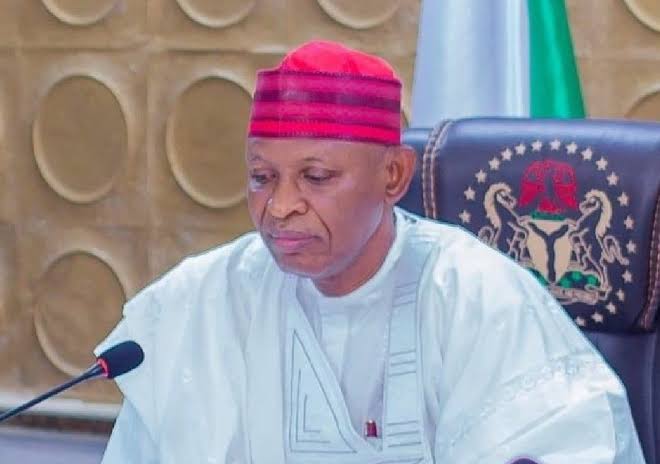
Kano State Governor, Abba Kabir Yusuf, has offered contrasting accounts of the political negotiations surrounding his relationship with President Bola Tinubu before the Supreme Court affirmed his election victory in January 2024, raising questions about the circumstances that preceded his eventual defection to the All Progressives Congress (APC).
In January 2024, shortly after the Supreme Court judgment, Yusuf publicly denied entering into any agreement or accepting conditions from the Presidency before the apex court ruled in his favour in the 2023 Kano governorship election dispute.
However, in a recent interview with BBC Hausa, the governor disclosed that his political mentor and then leader of the New Nigeria Peoples Party (NNPP), Rabiu Musa Kwankwaso, personally sent him to Tinubu to negotiate a political arrangement under which they would join the APC if the Supreme Court upheld his election.
The latest revelation has brought renewed attention to the political circumstances surrounding Yusuf’s eventual departure from the NNPP, particularly his earlier insistence that no agreement existed between him and the Presidency.
What Yusuf said in January 2024
On January 29, 2024, Yusuf, through his Director-General on Media and Publicity, Sanusi Bature Dawakin Tofa, dismissed reports that he had entered into an agreement with the Presidency to defect to the APC following the Supreme Court judgment.
In a statement, the governor described the reports as false and insisted that he neither signed an agreement nor accepted any conditions before the Supreme Court delivered its judgment on January 12, 2024.
“Our attention has been drawn to a misconception making round on social media indicating an agreement between the Presidency and Governor Abba Kabir Yusuf in the aftermath of the Supreme Court judgment that affirmed his mandate.
“I wish to categorically state that Governor Yusuf did not enter into any agreement or condition with anybody before the Supreme Court judgment. I therefore urge the public to dismiss the fallacy being orchestrated by enemies of progress,” the statement said.
The statement specifically rejected claims that Yusuf had agreed to defect to the APC, dissolve or recognise the five emirates, discontinue the demolition of illegal structures or establish a Kano Elders Council as conditions attached to his political relationship with the Presidency.
It further maintained that Tinubu had demonstrated political neutrality during the governorship election litigation despite pressure from some members of his party.
According to the statement, the President allowed justice to prevail and did not interfere with the judicial process to favour the APC candidate, Nasiru Yusuf Gawuna.
Yusuf also expressed appreciation to Tinubu, describing him as a democrat who allowed a level playing field despite pressure from political interests within and outside Kano.
The governor maintained that his meetings with the President were focused on the development of Kano State.
What Yusuf revealed in November 2026
Nearly three years after the January 2024 denial, Yusuf offered a different account of the political engagement with Tinubu in an interview with BBC Hausa.
This time, he said Kwankwaso personally instructed him to meet the President and assure him that they would join the APC if the Supreme Court affirmed his governorship election victory.
According to the governor, the arrangement was not initiated independently by him but was sanctioned by Kwankwaso, who was then his political leader and the NNPP’s national leader.
“He personally sent me to Tinubu. He asked me to meet him and assure him that if God granted us victory, we would move together,” Yusuf said.
He further alleged that Kwankwaso asked him to swear on the Qur’an before Tinubu as a demonstration of his commitment to the proposed political arrangement.
“In fact, he asked me to take the Qur’an and swear before Tinubu that if we won, we would unite and move forward together,” he added.
Yusuf said the understanding was for him, Kwankwaso and their supporters to move to the APC after a favourable Supreme Court judgment.
He explained that the proposed political alignment was partly informed by the need for Kano State to work closely with the Federal Government to secure greater cooperation and political support.
The governor consequently rejected accusations of betraying Kwankwaso, arguing that the former governor was fully aware of the negotiations and had personally authorised them.
“How can that be betrayal when he was the one who sent me to Tinubu and asked me to make those commitments?” he asked.
Yusuf also claimed that efforts were made to arrange a meeting between Kwankwaso and Tinubu, but the relationship subsequently deteriorated after the former Kano governor allegedly made unfavourable comments about the President.
The contradiction and questions raised
Although Yusuf’s latest account does not explicitly establish that he signed a written agreement with the Presidency, it confirms that, according to his own version of events, there were discussions and a political understanding involving Tinubu before the Supreme Court judgment.
Yusuf vs Kwankwaso: Governor’s wife seeks divorce, offers to refund Nikkah dowry
This creates an apparent contradiction with his January 2024 statement, which categorically denied entering into any agreement or accepting any conditions before the judgment.
The distinction between a written agreement and a verbal political commitment is important. While Yusuf denied signing an agreement or accepting conditions from the Presidency in 2024, his latest account suggests that he had made a commitment to join the APC if the Supreme Court ruled in his favour.
His latest disclosure also raises questions about why the 2024 statement did not acknowledge the alleged negotiations with Tinubu or Kwankwaso’s reported involvement in the arrangement.
Another question is whether the January 2024 denial was specifically intended to reject claims of a formal agreement with the Presidency or whether it also covered the alleged verbal understanding that Yusuf has now disclosed.
There is also the question of what changed between the alleged understanding before the Supreme Court judgment and Yusuf’s eventual political separation from Kwankwaso.
While the governor now insists that his former political mentor authorised the negotiations, his earlier public position presented a different picture of his relationship with the Presidency during the election dispute.
A political fallout with wider implications
The revelations come against the backdrop of the political breakdown between Yusuf and Kwankwaso, which eventually culminated in the governor’s defection from the NNPP to the APC.
Kwankwaso had been instrumental in Yusuf’s emergence as Kano governor in 2023, with the former governor’s political influence and the Kwankwasiyya movement playing a significant role in his electoral victory.
Their subsequent disagreement over Yusuf’s political direction has reshaped Kano’s political landscape and raised questions about the future of the Kwankwasiyya movement.
By attributing the initial APC negotiations to Kwankwaso, Yusuf is now presenting his defection as an outcome of an earlier political understanding rather than a unilateral decision or betrayal of his benefactor.
However, the former Kano governor’s account of the alleged arrangement has not been independently established through the statements presented in the two accounts.
Ultimately, Yusuf’s latest interview has reopened questions about the political dealings preceding the January 2024 Supreme Court judgment and placed his earlier denial under renewed scrutiny.
Whether the two accounts can be reconciled through the distinction between a formal written agreement and a verbal political understanding remains a question the governor needs to clarify publicly.

- How Gov Yusuf’s latest disclosure reopens 2024 Tinubu agreement controversy - November 23, 2026
- Unilever Nigeria to transfer foods business to McCormick subsidiary - November 23, 2026
- Fire destroys 56 stalls, six shops, mosque in Yobe market - November 23, 2026