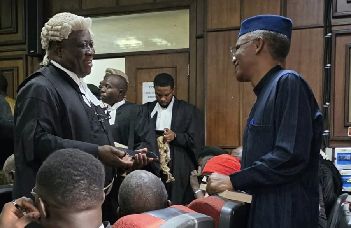
The Independent Corrupt Practices and Other Related Offences Commission (ICPC) and the Attorney-General of the Federation (AGF) have asked the Federal High Court in Abuja to dismiss the N1 billion fundamental rights suit filed by former Kaduna State Governor Nasir El-Rufai over alleged denial of access to his family while in detention.
El-Rufai, who is being held in ICPC custody, filed the suit against the anti-graft agency, its Chairman, Musa Aliyu (SAN), and the AGF, saying his wife, Aichatou Asabe, and son, Abba El-Rufai, were prevented from seeing him. He is seeking N1 billion in damages and other reliefs.
In a counter-affidavit, the ICPC described the allegations as false, insisting El-Rufai is being lawfully detained under an order of the Federal High Court in Kaduna.

The commission said it complied with a court directive by allowing the former governor to see his personal physician, accompanied by ICPC officials and his wife. However, it claimed the visit was turned into a political meeting, prompting a review of its security procedures.
The agency said it subsequently imposed temporary restrictions on non-essential visits after identifying security vulnerabilities.
According to the ICPC, El-Rufai’s son attempted to gain access to the detention facility on July 7, while his wife allegedly forced her way into the premises after disregarding access protocols, an incident captured by the commission’s CCTV system.
El-Rufai reflects on silence of associates, says he seeks no revenge
The anti-graft agency also alleged that investigations uncovered an earlier security breach in which Asabe was secretly brought into the facility after official visiting hours with the help of an officer who has since been dismissed.
It added that the temporary suspension of her visiting rights was based solely on security concerns and not an attempt to violate El-Rufai’s rights.
The ICPC further argued that other members of the former governor’s family had continued to visit him after the July 7 incident, bringing food, medication and other necessities, contrary to his claims of total denial of access.
The AGF, in a separate counter-affidavit, also urged the court to dismiss the suit, arguing that it neither arrested nor detained El-Rufai and has no control over the ICPC’s detention facility.
The AGF added that the court order obtained by El-Rufai only authorised access to his lawyer and personal physician, not unrestricted family visits.
The AGF stated that the ICPC has the legal authority to enforce security protocols within its detention facilities and insisted that such measures are necessary to safeguard national security.
Both respondents urged the court to dismiss the suit, saying El-Rufai’s allegations lack merit.