


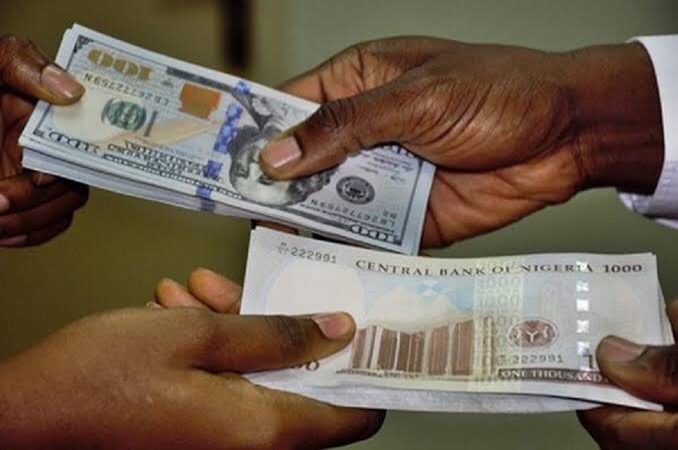
Nigeria’s naira ended the trading week at N1,374 to the United States dollar on Thursday, extending a week-on-week depreciation amid sustained volatility in the foreign exchange market and a decline in the country’s external reserves.
Data from the Central Bank of Nigeria showed the local currency traded at N1,369/$ on Monday, climbed to N1,383/$ on Tuesday, eased to N1,370.5/$ on Wednesday before settling at N1,374/$ on Thursday. Friday’s session was suspended due to the Workers’ Day public holiday.
The closing rate marks a weakening from N1,361.5/$ recorded the previous Friday and N1,355/$ the Thursday before it, with the naira trading within a weekly band of N1,369/$ and N1,383/$.
Nigeria’s external reserves fell to $48.36 billion as of April 29, down from $48.51 billion on April 21.
Market sources attributed the decline to CBN interventions and external obligations, with reserves shedding approximately $731 million in the first three weeks of April alone.
Analysts and traders have also pointed to structural constraints in the retail foreign exchange segment, particularly limited Bureau De Change operator access to the official market, as a factor suppressing supply.
Global dollar strength has compounded the pressure, with the US dollar index hovering around 98.57 amid investor anticipation of Federal Reserve policy decisions — a development that has weighed broadly on emerging market currencies.
CBN Governor Olayemi Cardoso has, however, sought to reassure markets, stating that the apex bank is equipped to manage reserve fluctuations and projecting that reserves could reach $51 billion by year-end as part of its broader stabilisation strategy.
In international markets, the euro and pound traded within narrow ranges, while the Japanese yen held near 160 to the dollar amid geopolitical uncertainties.

- FG rules out immediate electricity tariff hike, prioritises metering - September 18, 2026
- Nigeria’s $400bn net-zero ambition faces financing hurdle - September 18, 2026
- Workers warn Oyedele over delayed 40% allowance, promotion arrears - September 18, 2026