


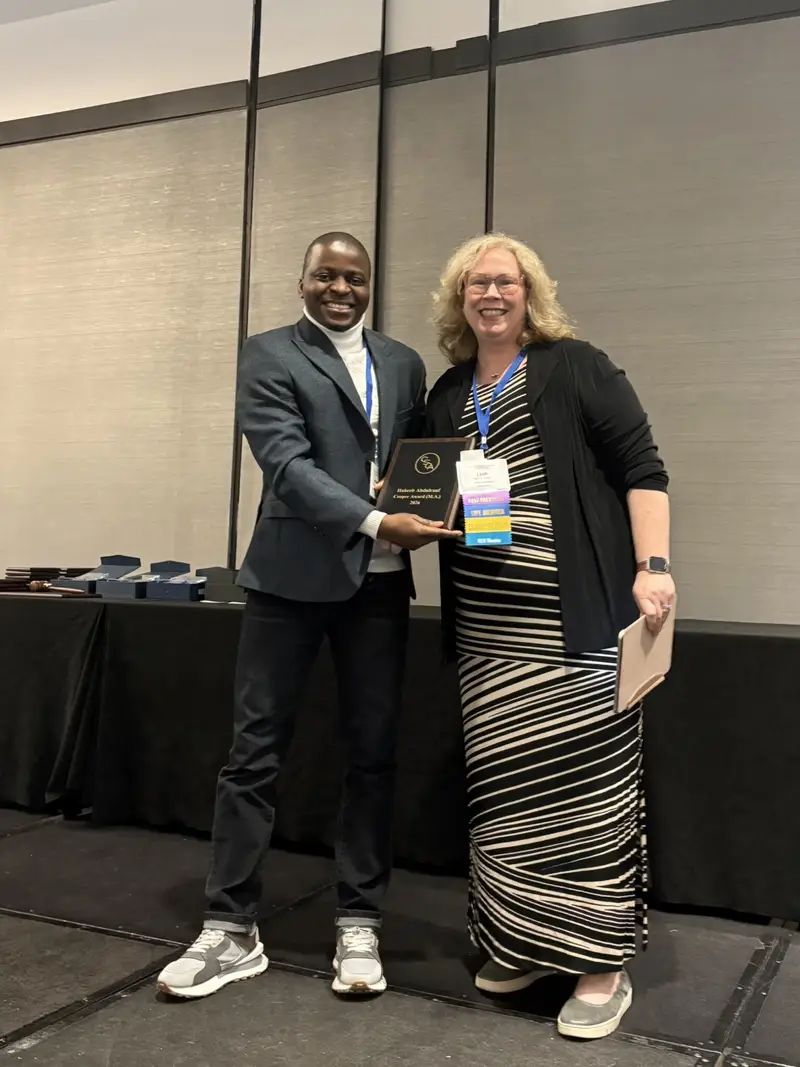
Nigerian scholar Habeeb Abdulrauf has earned international recognition after receiving a prestigious teaching award in United States and leading a high-impact workshop on human-robot interaction at the 2026 convention of the Central States Communication Association (CSCA).
Abdulrauf was honoured as the 2026 recipient of the CSCA President Pamela J. Cooper Graduate Teaching Award at the master’s level, one of the association’s most competitive accolades for excellence in graduate instruction.
The recognition was conferred during the CSCA Annual Conference held from April 14 to April 19 at the Hyatt Regency in Minneapolis, Minnesota, a major gathering of communication scholars and educators across the United States.

At the conference, Abdulrauf chaired a session titled “Emerging Tech Tools Showcase: Teaching Smarter, Researching Faster”, where he led a practical workshop exploring innovations in human-robot interaction and AI-driven research tools.
The session featured contributions from Shalewa Babatayo of the University of Central Florida and Chidalu Glory Nnorukah of Western Michigan University, who demonstrated tools such as NotebookLM, ResearchRabbit, and Elicit for advancing scholarly research and enhancing student-centred teaching.
Abdulrauf also presented a hands-on demonstration of Peerbots, an open-source robot-puppeteering platform that enables researchers to design and test human–AI and human–robot interaction experiments without advanced programming.
Uba Sani bags NIPR fellowship, named World PR Forum Ambassador
The session showcased how smartphones mounted on low-cost 3D-printed casings can function as interactive robotic systems, allowing researchers to prototype experiments using cost-effective methods.
“This approach lowers the barrier to entry for conducting human–robot interaction studies and allows researchers to focus on testing concepts before investing in full system development,” Abdulrauf said.
Reacting to the achievement, the Director of the School of Communication at Western Michigan University, Cynthia Klekar-Cunningham, lauded Abdulrauf’s contributions.
“Abdulrauf consistently demonstrates excellence in both teaching and innovation, and we are proud of how he represents and elevates the School of Communication on national and international stages,” she said.
Abdulrauf’s work focuses on human-AI interaction, AI in health communication, and the development of accessible technological systems for low-resource settings.

- Aston Villa end goal drought, beat Club Brugge in Champions League opener - September 8, 2026
- Drama as man drags fiancée to court, seeks return of wedding gifts - September 8, 2026
- Yamal: I won’t beg for Ballon d’Or - September 8, 2026