

As investigations continue into the alleged foiled coup plot against President Bola Tinubu’s administration, new details have emerged about the identities and service backgrounds of 16 senior military officers currently being held by authorities.
According to exclusive information obtained by PREMIUM TIMES, fourteen of the detained officers are from the Nigerian Army, while the remaining two are personnel of the Nigerian Navy and Air Force.
Sources familiar with the investigation revealed that 12 of the army officers belong to the Infantry Corps, the main combat arm of the Nigerian Army responsible for ground operations.
One officer serves in the Signals Corps, which handles military communications, while another is from the Ordnance Corps, responsible for the storage and maintenance of weapons, ammunition, and logistics.
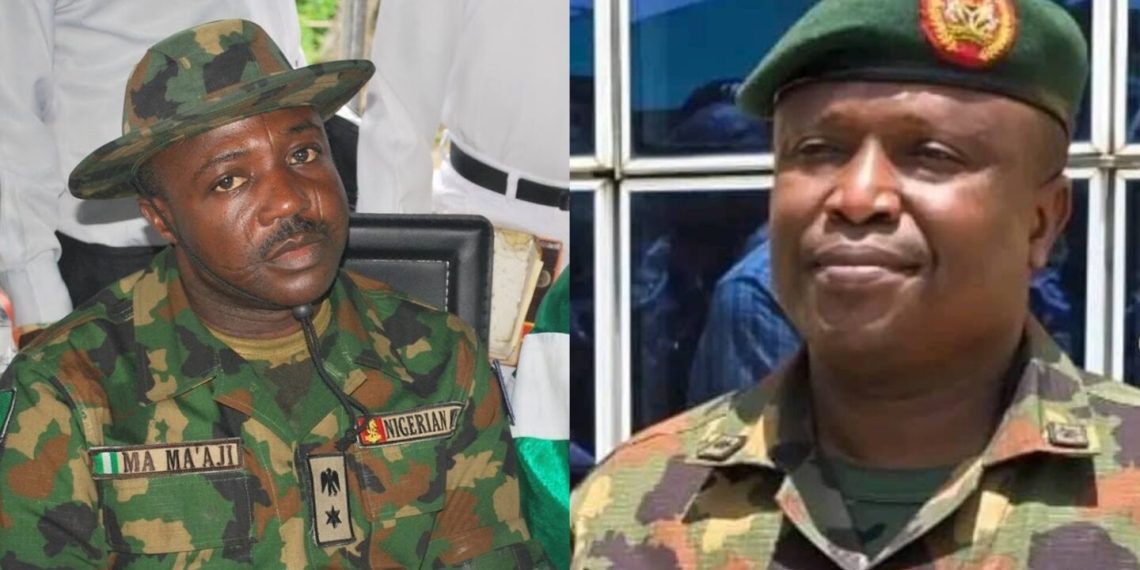
Among those detained is Brigadier General Musa Abubakar Sadiq, believed to be the prime suspect and alleged leader of the plot.
Born on January 3, 1974, Sadiq hails from Nasarawa State and is a member of the 44 Regular Course of the Nigerian Defence Academy (NDA), where he trained between 1992 and 1997.
A decorated Infantry officer, he rose to the rank of colonel in 2015 and brigadier general in 2019, serving as Commander of the 3rd Brigade in Kano and later as Garrison Commander of the 81 Division in Lagos. In 2024, he was briefly detained over allegations of diverting rice palliatives and selling military equipment.
Another key suspect, Colonel M.A. Ma’aji, from Niger State, was born on March 1, 1976. A member of the 47 Regular Course of the NDA, he began his military career in 1995 and was commissioned in 2000.
He served in several capacities, including as Commanding Officer of the 19 Battalion in Okitipupa, Ondo State, and also participated in Operation Crocodile Smile II in the Niger Delta.
Other officers under investigation include Lieutenant Colonel S. Bappah from Bauchi State, an officer of the Signals Corps born in 1984 and trained under the 56 Regular Course, and Lieutenant Colonel A.A. Hayatu from Kaduna State, another 56 Regular Course graduate of the Infantry Corps.
Lieutenant Colonel P. Dangnap from Plateau State, who was previously court-martialed in 2015 alongside 29 others for offences related to the Boko Haram war, is also among the detained.
Lieutenant Colonel M. Almakura, also from Nasarawa State, and a member of the 56 Regular Course, was born in 1983 and serves in the Infantry Corps. Others include Major A.J. Ibrahim from Gombe State, a 56 Regular Course Infantry officer born in 1987; Major M.M. Jiddah from Katsina State, another Infantry officer of the same course; and Major M.A. Usman from the Federal Capital Territory, born in 1989 and a member of the 60 Regular Course.
Also in custody is Major D. Yusuf from Gombe State, an officer of the Ordnance Corps born in 1988 and trained under the 59 Regular Course, as well as Major I. Dauda from Jigawa State, who joined the army through the Short Service Commission in 2009.
Other detained officers include Captain Ibrahim Bello, born in 1987 and a member of the Direct Short Service Course 43, and Captain A.A. Yusuf, whose details remain sketchy.
The list also includes Lieutenant S.S. Felix, a junior Infantry officer, Lieutenant Commander D.B. Abdullahi of the Nigerian Navy, and Squadron Leader S.B. Adamu of the Nigerian Air Force.
The two non-army officers are said to have played minor logistical and coordination roles within the wider network.
Investigations have intensified in recent weeks, with military intelligence operatives tracking communication records and financial transactions allegedly linked to the plot.
Some of the detained officers, according to sources, were reportedly influenced by political sponsors who promised them rapid promotions and financial rewards.
The Defence Headquarters has maintained silence over the development, only stating earlier that the alleged coup was not the reason behind the low-key Independence Day celebration on October 1.
Meanwhile, defence insiders insist that the military remains firmly committed to Nigeria’s democratic order, despite what they describe as “the gravest internal subversion attempt in recent history.”
Security analysts have commended the Defence Headquarters for discreetly containing the situation, noting that the swift response helped prevent what could have been a violent and destabilising episode in the country’s political history.
However, they warn that the underlying grievances within the armed forces that may have inspired such discontent must be urgently addressed to avoid future threats to national stability.

- Global markets brace for oil shock after US–Israel strikes - March 1, 2026
- Kwara poly set for academic restart after protest - March 1, 2026
- UAE air defences repel 165 ballistic missiles - March 1, 2026