
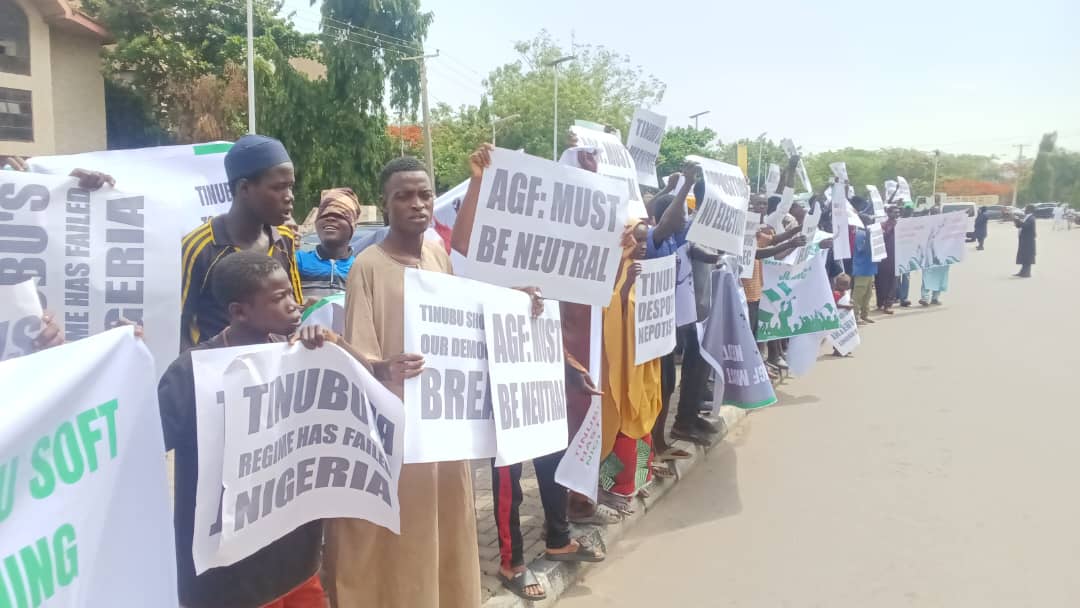

Tension heightened on Monday at the Federal High Court as dozens of demonstrators gathered to protest a legal move seeking the deregistration of several opposition political parties.
The protesters, operating under the banner of Concerned Northern Nigeria Stakeholders, converged at the court premises in Wuse, Abuja, chanting solidarity songs and displaying placards bearing messages such as “No Opposition, No Election,” and “Tinubu, Let Our Democracy Breathe.”
Security personnel, including operatives of the Department of State Services, barricaded the entrance to the court and denied the demonstrators access to the complex.
Speaking to journalists, the group’s leader, Banki Sharrif, expressed concern over what he described as increasing threats to judicial independence and democratic institutions. He accused the Federal Government of attempting to undermine due process and weaken opposition voices.
Sharrif called on Bola Ahmed Tinubu to refrain from any form of interference in the judiciary, warning that manipulating the justice system could erode public trust and destabilise the country’s democratic framework.
He argued that democracy depends on credible opposition, stressing that efforts to suppress political parties signal a lack of confidence in governance. According to him, elections without viable opposition risk losing legitimacy.
The group also raised concerns about the role of the Attorney General of the Federation and Minister of Justice, Lateef Fagbemi, urging that the office remain neutral and not be used for political purposes.
Sharrif alleged that there were moves to use legal technicalities to delist certain political parties, particularly those with strong support in Northern Nigeria, warning that such actions could deepen divisions and trigger unrest if not handled with strict adherence to due process.
The protesters cautioned that public confidence in the judiciary could deteriorate if courts are perceived as aligned with the executive arm of government, noting that loss of trust in legal institutions could push citizens toward extra-judicial means of seeking redress.
The protest comes amid rising political tension over a suit backed by the Attorney General, asking the court to compel the Independent National Electoral Commission to deregister several political parties.
Among those listed in the case are the African Democratic Congress, Action Peoples Party, Action Alliance, Accord Party, and the Zenith Labour Party.
In court filings, the Attorney General argued that the continued existence of the affected parties contravenes provisions of the 1999 Constitution of Nigeria and undermines electoral integrity. He maintained that INEC would be failing in its constitutional duties if it retains parties that do not meet legal requirements.
The AGF, through a legal team led by Joshua Olatoke, insisted that his actions are in line with his responsibility as the chief law officer of the federation to uphold the Constitution and ensure compliance with electoral laws.
The case and the protest have further intensified debates over the state of Nigeria’s democracy and the role of institutions in safeguarding political pluralism.

- Osun challenges EFCC over restriction of state account - August 8, 2026
- Why Abuja remains under federal police — Senate - August 8, 2026
- Peter, Paul’s rift may be beyond repair — Brother - August 8, 2026