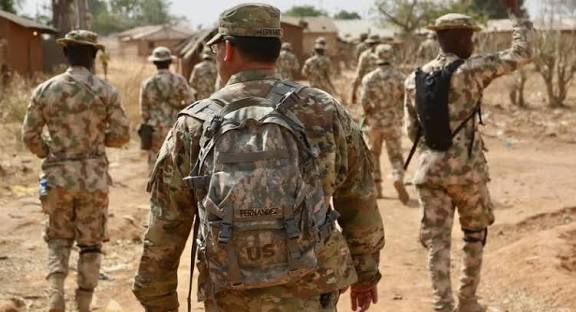
The United States has scaled down its military presence in Nigeria following a successful joint operation against Islamic State (ISIS) militants, but says it will continue supporting Nigerian forces through intelligence sharing.
The Commander of the U.S. Africa Command (AFRICOM), General Dagvin Anderson, disclosed this on Thursday while speaking to journalists after a conference of African defence chiefs in Luanda, the capital of Angola.
Anderson said most of the U.S. troops deployed specifically for the operation have been withdrawn, with the partnership now focused on providing intelligence support requested by Nigeria.
“We have withdrawn much of our forces that were just there for that operation, but are continuing the partnership that Nigeria has asked for to help continue with the intelligence sharing,” he said.
The operation, carried out in May by U.S. and Nigerian troops in the Lake Chad Basin, led to the killing of Abu-Bilal al-Minuki, described as the Islamic State’s second-in-command worldwide.
The mission followed a U.S. strike on Christmas Day ordered by President Donald Trump, targeting ISIS militants accused of attacking Christians in Nigeria.
Anderson said the operation exemplified the U.S. approach to security cooperation in Africa, where American forces provide specialised capabilities while local militaries take the lead in combat operations.
He noted that the joint offensive dealt a significant blow to ISIS by disrupting its leadership hierarchy, communications and operational network, with effects extending beyond West Africa due to the group’s global reach.
The AFRICOM commander commended the Nigerian military for sustaining the momentum against the terrorists after the operation, saying troops had continued to target ISIS fighters independently.
“Nigeria has been very active since that operation in May. They continue to prosecute targets themselves,” he said.
He added that sustained military pressure and public awareness of the successful operation had prompted more ISIS fighters in northeastern Nigeria to surrender or defect.
The three-day conference in Luanda was attended by defence chiefs from 35 African countries, alongside military representatives from the United States and Brazil.

- OAU lecturer wins $5m Gates Foundation grant to tackle maternal deaths in Nigeria - October 9, 2026
- Wike orders demolition of illegal beer parlours in Abuja - October 9, 2026
- FG bars MDAs from buying vehicles from unregistered suppliers - October 9, 2026