

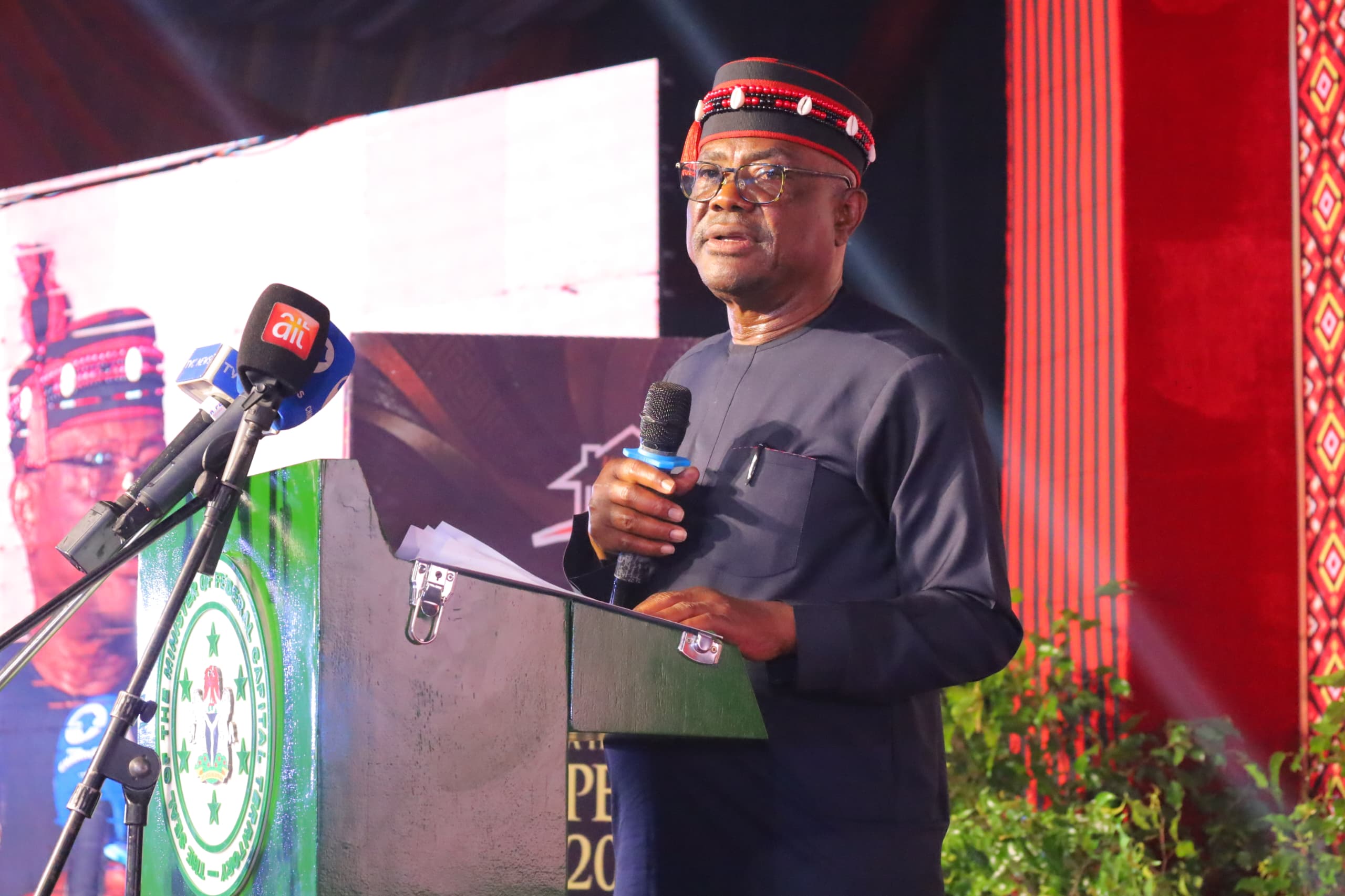
Minister of the Federal Capital Territory, Nyesom Wike, has urged Nigerians to reject politicians he described as “political gamblers”, accusing some presidential hopefuls of exploiting the plight of vulnerable citizens to advance their ambitions.
Wike, who spoke on Thursday at the inaugural Idoma Hall of Fame induction ceremony in Benue State, questioned the sincerity of politicians who, according to him, began visiting internally displaced persons’ camps to celebrate their birthdays only after deciding to seek the presidency.
He challenged Nigerians to examine the records and intentions of political leaders rather than allow ethnic loyalty, political calculations or grievances over marginalisation to influence their choices.
The minister delivered the remarks while presenting a keynote address titled, “People, Politics and Power Play in Nigeria: The Agitation for Equity and Fairness”, as part of the Idoma Centenary Plus celebration.
He warned that demands for equity and fairness should not become tools for political opportunism or attempts by competing groups to gain access to public resources for personal benefit.
“One of the enduring difficulties of our political life is the tendency to convert public power into private possession,” Wike said.
He argued that changing the ethnic or regional group controlling political power would not address injustice if the benefits of governance remained concentrated among a few.
“If one group replaces another at the table while the benefits remain fundamentally exclusionary, the occupants have changed, but the injustice has not,” he said.
Wike also criticised what he described as selective opposition to marginalisation, arguing that some people condemn exclusion only when their own communities are affected.
“If we complain about marginalisation only when our own people are excluded, but become silent when others are marginalised after our people gain power, we are not opposing injustice; we are seeking access to its privileges,” he said.
The FCT minister maintained that political inclusion should be measured by improvements in citizens’ living conditions rather than the identities of those occupying public offices.
He listed employment, quality education, healthcare, infrastructure, electricity, security and economic opportunities as key indicators of meaningful inclusion.
According to him, Nigeria’s diversity should strengthen national unity rather than provide grounds for exclusion, while the pursuit of equitable representation must not undermine competence.
“A Nigerian should not be excluded from public office because of where he or she comes from; neither should competence become irrelevant once a candidate’s identity satisfies a representational expectation,” he said.
Wike acknowledged that Nigeria had adopted mechanisms such as federalism, state creation, revenue allocation, zoning and rotational presidency to accommodate its diversity, but said these arrangements alone could not guarantee fairness.
He called for a political culture that treats public office as a trust rather than an entitlement and prioritises the common good over ethnic or sectional interests.
The event, organised in collaboration with Och’Idoma, also featured the induction of distinguished members of the Idoma community into the Hall of Fame. Wike commended the organisers for their efforts to preserve Idoma history and inspire future generations.

- Wike to Nigerians: Reject ‘political gamblers’ seeking presidency - October 15, 2026
- Tinubu seeks overhaul of NDLEA, expands NSIB mandate, replaces ASCON - October 15, 2026
- Zamfara auditor flags financial breaches, issues queries to 98 MDAs - October 15, 2026