

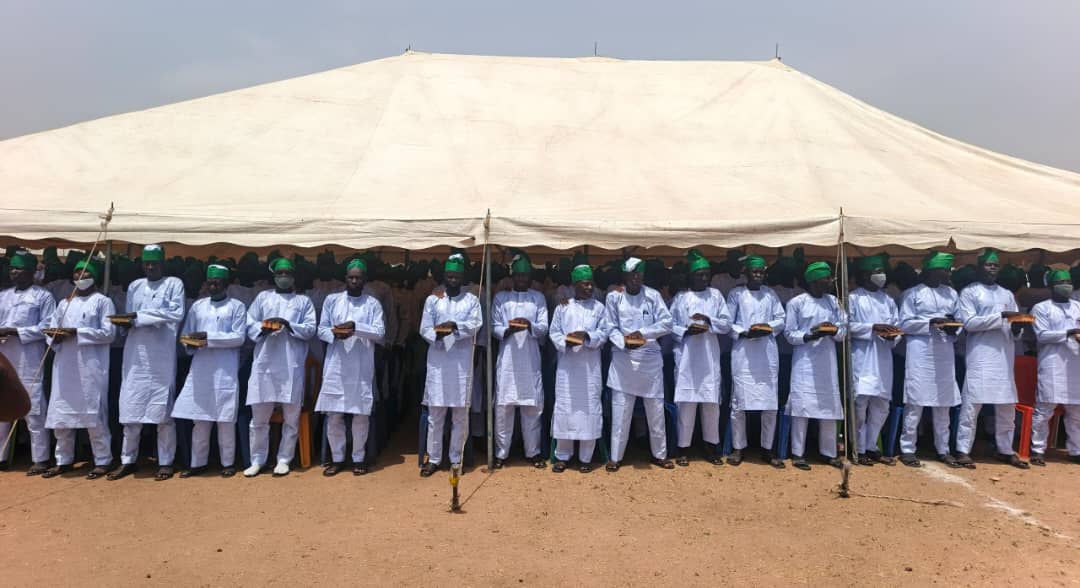

No fewer than 744 former terrorists and victims of violent extremism have completed the Federal Government’s De-radicalisation, Rehabilitation and Reintegration programme under Operation Safe Corridor, in what military authorities described as a significant milestone in Nigeria’s non-kinetic strategy against insurgency.
The graduation ceremony held on Thursday in Gombe brought together repentant fighters and coerced participants drawn from 17 states and four countries, underscoring the broad geographic sweep of the North-East conflict and its ripple effects across Nigeria and the Lake Chad Basin.
Borno State accounted for the largest share of graduates with 597, followed by Yobe State with 58, Kano with 15, Adamawa with 10, and Bauchi with 12. Other states represented include Abia, Akwa Ibom, Anambra, Ebonyi, Enugu, Katsina, Kebbi, Kogi, Nasarawa, Niger, Plateau, and Sokoto. Among the graduates are eight foreign nationals — four from Niger Republic, two from Chad, and one each from Burkina Faso and Cameroon. Of the 744 graduates, 733 are Muslims and 11 are Christians.
Chief of Defence Staff General Olufemi Oluyede, represented at the event by Rear Admiral Kabiru Tanimu, Director of Special Operations Forces at Defence Headquarters, made clear that the programme was neither a concession nor a reward for violence but a calculated strategic instrument.
“Operation Safe Corridor is not an amnesty programme, and it is not a sign of weakness. It complements military operations by addressing the human threats of conflict, reducing recidivism and weakening the ideological foundations of violent extremism,” Oluyede said.
Addressing the graduates directly, the CDS urged them to honour the opportunity they had been given.
“Nigeria is giving you a second chance; do not waste it. You are returning not just to your communities but to a responsibility to live peacefully, to contribute meaningfully and to reject all forms of violence and extremism,” he said.
Programme Coordinator Brigadier General Yusuf Ali said the initiative was conceived on the recognition that military force alone cannot deliver lasting peace.
“While military operations continue to degrade and neutralise threats, it became evident that lasting peace requires a structured pathway for disengagement, rehabilitation and reintegration of those willing to renounce violence,” Ali said.
He described the curriculum as holistic, encompassing psychosocial support, vocational training, religious reorientation, educational reform, civic education, and behavioural transformation. Ali also noted that a significant number of the participants had not joined extremist groups voluntarily.
“Some were abducted, others were forced, and many were drawn into the conflict due to circumstances beyond their control. But today marks a turning point,” he said.
Gombe State Governor Muhammad Yahaya, represented by his SSA on Security and Intergovernmental Affairs, Ambassador Yusuf Musa, urged the graduates not to squander their second chance.
“Go forward and become responsible, law-abiding, and productive citizens who will contribute positively to your community and the nation at large. Do not betray the trust that Nigeria has placed in you,” Musa said.
Both military and civilian officials stressed that the success of the reintegration process ultimately rests with state governments, community leaders, families, and institutions, calling on all stakeholders to receive, monitor, and support returning individuals.
Established as a structured response to the Boko Haram insurgency, Operation Safe Corridor has evolved into a multi-agency initiative backed by local institutions and international partners. Thursday’s graduation reinforces Nigeria’s sustained shift toward combining conventional military operations with de-radicalisation efforts as part of a broader strategy to achieve durable stability in the North-East and beyond.

- CUSTECH expels two students over same-sex conduct, rusticates four - July 24, 2026
- Supreme Court upholds Oyebanji’s APC nomination, dismisses appeal - July 24, 2026
- Court sentences man to death for murdering pregnant woman - July 24, 2026