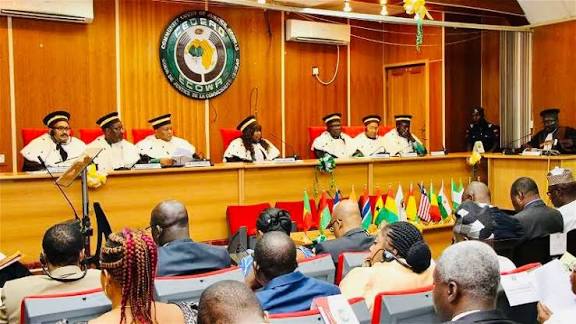
The ECOWAS Court of Justice has proposed sweeping reforms aimed at strengthening regional justice, including the creation of an appellate chamber and tougher mechanisms to ensure member states comply with its judgements.
The recommendations were adopted at the Court’s 2026 International Conference in Dakar, Senegal, and outlined in a communique issued at the close of the event on Friday, September 25, 2026.
According to the communique, the proposed Appeal Division would require amendments to the ECOWAS Revised Treaty and other legal instruments. The reforms would define the appellate court’s jurisdiction, procedures, timelines, qualifications for judges and the effect of appeals on the enforcement of judgments.
The conference noted that an appellate structure would enhance the right to a fair hearing, correct judicial errors and promote consistency in the Court’s decisions. However, participants stressed that creating such a body alone would not resolve the region’s poor record of compliance with court rulings.
To preserve its independence, the conference recommended a transparent and non-political process for appointing appellate judges, backed by adequate financial and human resources. It also suggested that the appellate chamber could sit periodically instead of permanently to reduce costs.
A major concern raised during the conference was the poor implementation of the Court’s decisions. According to the communiqué, only about 18 to 22 per cent of enforceable judgments have been complied with, while some ECOWAS member states have failed to implement any judgment delivered against them.
Participants attributed the low compliance rate to the Court’s lack of coercive powers, failure by member states to domesticate ECOWAS laws, resistance from some national courts and weaknesses in the existing enforcement framework.
Nigeria asks ECOWAS to reopen dialogue with Sahel bloc
To address the challenge, the conference recommended stronger diplomatic engagement with member states, including reporting persistent non-compliance to the ECOWAS Authority of Heads of State and Government and the Council of Ministers.
It also proposed establishing a regional mechanism to monitor the execution of judgments, creating a compliance-monitoring unit within the ECOWAS Commission and requiring the Court to publish annual reports on member states’ compliance records.
Other recommendations included clarifying sanctions for persistent non-compliance, considering monetary penalties, establishing a compensation fund for victims of rights violations and encouraging member states to domesticate Community laws.
Beyond judicial reforms, the conference also called for stronger safeguards on artificial intelligence and digital rights, improved environmental accountability, enhanced protection for refugees and displaced persons, and decisive action against xenophobic attacks within the ECOWAS region.

- President Lula bans sports betting ahead of Brazil’s election - September 26, 2026
- ECOWAS Court mulls Appeal Division, stronger judgement enforcement - September 26, 2026
- Security guard rape, kill 11-year-old girl in Niger State - September 26, 2026